
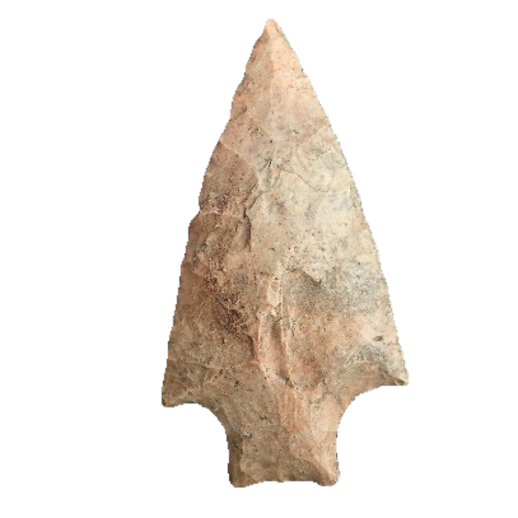
Arrowhead type
Levy Point
LevyArchaic Stemmed Cluster6,000 - 3,500 B.P.Middle Archaic to Late Archaic17 reference photos
Key facts
- Age
- 6,000 - 3,500 B.P.
- Cultural period
- Middle Archaic to Late Archaic
- Size
- Medium to Large
- Shape
- Straight Stem to Contracting Stem
- Glacial period
- Middle Holocene to Neoglacial
More from the Archaic period
Description
This triangular stemmed point exhibits a robust profile, measuring between 2 to 4.5 inches in length, with a cross-sectional shape that is elliptical in outline. The blade edge displays a range of curvature, from straight to excurvate, while the shoulders are generally broad, sometimes featuring a slight barb or an upward inclination. The stem's morphology varies, ranging from contracting to nearly straight. A distinctive characteristic of this point is its concave base, which is often accompanied by sharp or pointed basal corners, achieved through the thinning of the base. The flaking pattern observed on this specimen is random, lacking a discernible order or orientation.
Size
The dimensions of the arrowheads are characterized by the following measurements: overall length ranges from 40 to 120 mm, with a mean length typically falling between 55 and 65 mm. The stem, a distinctive feature, measures between 13 and 18 mm in length. In terms of width, the arrowheads span from 35 to 60 mm, while the stem width specifically is between 15 and 20 mm. The thickness of these artifacts varies from 5 to 13 mm.
Distribution
This type is mainly discovered in Florida and extends into Southwestern Georgia and Southeastern Alabama.
Additional information
The Florida Archaic Stemmed type, a distinct category of Native American arrowheads, has been extensively studied and categorized. Notably, four subtypes have been identified within this classification, namely Alachua, Levy, Marion, and Putman, as initially recognized by Bullen and later referenced by Farr in 2006. A closer examination of these subtypes reveals that the Putman subtype is the earliest, characterized by a contracting stem and a convex base. In contrast, the Alachua, Levy, and Marion subtypes appear to be contemporaneous, with their variations primarily distinguished by differences in stem morphology. According to Granger and Granger's research in 2013, these subtle distinctions have enabled archaeologists to subdivide the Florida Archaic Stemmed type into more specific categories. Interestingly, points belonging to this type are among the most frequently discovered in Florida, underscoring their significance in the state's archaeological record, as also highlighted by Granger and Granger in 2013.
Identified by
- Named by
- Ripley P. Bullen
- Year
- 1968
Similar types
Types that are easy to confuse with the Levy point.
- Abbey
- Cypress Creek
- Hardee Beveled
- Kirk Stemmed
- Marion
- Newnan
- Putnan
- Six Mile Creek
Other types in the Archaic Stemmed Cluster
- Alachua
- Arredondo
- Hamilton
- Kirk Serrated
- Putnam
- Sumter
- Thonotosassa