
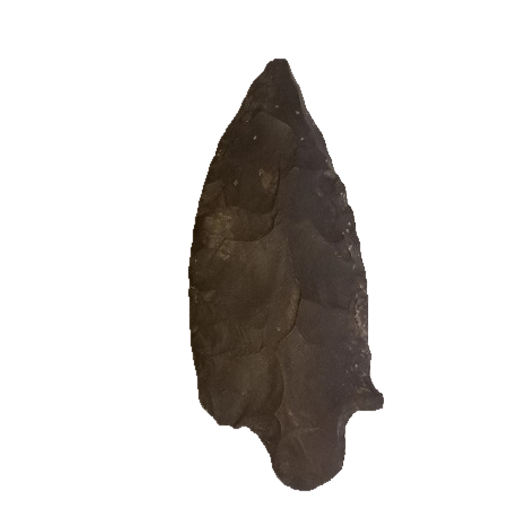
Arrowhead type
Ledbetter Point
LedbetterLedbetter Stemmed Cluster4,500 - 2,800 B.P.Late Archaic to Early Woodland18 reference photos
Key facts
- Age
- 4,500 - 2,800 B.P.
- Cultural period
- Late Archaic to Early Woodland
- Size
- Medium to Large
- Shape
- Straight Stem to Contracting Stem to Corner Notch
- Glacial period
- Neoglacial
Description
This triangular point exhibits a notable asymmetry, measuring between 2.25 and 4.00 inches in length, with an elliptical cross-sectional profile. The blade's curvature is characterized by a distinctive combination of recurvate forms, where one edge may display an outward recurvate, while the opposing edge exhibits an inward recurvate, as observed by Kneberg (1956). Alternatively, some specimens may feature a single excurvate edge paired with a straight edge. The shoulders of this point also demonstrate asymmetry, with one side being wider than the other, and the orientation of the shoulders differing, with one being horizontal and the other sloping upward. The base of the point can vary, ranging from slightly expanding to slightly contracting, although a straight base is the most common configuration. The flaking pattern on this point is random, lacking a consistent or deliberate arrangement.
Size
The dimensions of the arrowheads are characterized by the following measurements: overall length ranges from 55 to 100 mm, with a mean length of 65 to 75 mm. The stem length varies between 8 and 18 mm, averaging 12 to 14 mm. The width of the blade spans 25 to 53 mm, with a typical range of 35 to 45 mm. At the shoulders, the stem width measures between 16 and 25 mm, commonly falling within 18 to 21 mm. The basal width is recorded as 11 to 19 mm, with an average of 13 to 15 mm. Lastly, the thickness of the arrowheads is measured at 9 to 13 mm.
Distribution
This type is mainly located in the Tennessee River basin and along the Gulf Coast region. It also appears with decreased regularity in the southern parts of Illinois, Indiana, Ohio, and the Tennessee River drainages of West Virginia, Virginia, and North Carolina
Additional information
In the realm of Native American archaeology, a notable artifact has been identified as a knife, potentially associated with the same cultural group that utilized the Pickwick point. A distinctive characteristic of this point is its asymmetrical design, particularly evident in the blade and shoulders. This observation was first noted by Kneberg in 1956, highlighting the significance of this feature in identifying the point's cultural origins.
The Ledbetter cache, discovered in Kentucky, provides a relevant example of this asymmetrical design. The cache included a knife blade that exhibited a similar asymmetry, underscoring the importance of this characteristic in understanding the cultural context of these artifacts. The presence of such a blade in the Ledbetter cache suggests a possible connection between the cultural group that created the Pickwick point and those who utilized the knife, warranting further investigation into the technological and stylistic similarities between these artifacts.
The asymmetrical design of the blade and shoulders is a notable characteristic of this point, offering valuable insights into the cultural and technological practices of the associated Native American group. By examining the Ledbetter cache and other relevant archaeological findings, researchers can gain a deeper understanding of the cultural dynamics and exchange networks that existed among Native American communities, ultimately enriching our knowledge of their technological, social, and cultural developments.
Identified by
- Named by
- Madeline Kneberg
- Year
- 1956
- Type site
- Ledbetter Site, Benton County, Tennessee
Similar types
Types that are easy to confuse with the Ledbetter point.
- Appalachian
- Ashtabula
- Cotaco Wright
- Cottonbridge
- Little Bear Creek
- Savannah River