
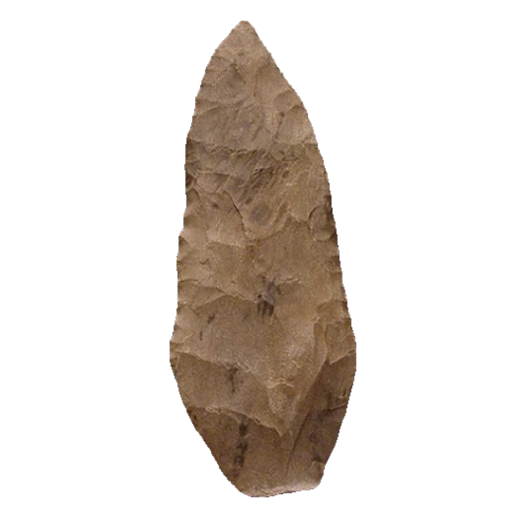
Arrowhead type
Maples Point
MaplesLedbetter Stemmed Cluster4,500 - 3,500 B.P.Middle Archaic to Late Archaic8 reference photos
Key facts
- Age
- 4,500 - 3,500 B.P.
- Cultural period
- Middle Archaic to Late Archaic
- Size
- Large
- Shape
- Contracting Stem to Ovoid
- Material
- Limestone
- Glacial period
- Neoglacial
More from the Archaic period
Description
This triangular blade exhibits a distinctive morphology, characterized by a broad, excurvate shape and a cross-sectional profile that ranges from flattened to elliptical. Measuring between 2.5 and 4.75 inches in length, its expansive form is complemented by a short, broad stem that contracts to a base with a pronounced convex curvature, although some specimens display a nearly straight base. The shoulders of the blade are marked by an upward inclination. Notable features of this point type include basal grinding and thinning, which are commonly observed. The flaking pattern on these blades is random, lacking a discernible order or orientation.
Size
The dimensions of the arrowheads are as follows: they exhibit a total length range of 61 to 119 millimeters, with an average measurement of 61 millimeters. The stem length varies from 8 to 16 millimeters, averaging 11 millimeters. The blade width spans 37 to 72 millimeters, with a mean width of 52 millimeters. In terms of stem width, the measurements fall between 24 to 50 millimeters, with an average of 24 millimeters. The thickness of the arrowheads ranges from 10 to 18 millimeters.
Distribution
This projectile is distributed throughout the Tennessee River basin. Predominantly discovered in Northern Alabama and extending into Tennessee
Also found, less often, in
Additional information
In a notable observation, Perino (1997) proposes that a particular arrowhead specimen may serve as a preform, specifically for the development of the Abbey point. This suggestion highlights the potential transitional role of this point in the evolution of Native American arrowhead technology. The Abbey point, a distinct type of arrowhead, is characterized by its unique morphology, which may have originated from earlier, more rudimentary forms such as the one identified by Perino. By recognizing this possible preform, researchers can gain valuable insights into the technological and cultural developments of the Native American groups that crafted these arrowheads, ultimately enriching our understanding of their technological and artistic expression.
Identified by
- Named by
- James Cambron
- Year
- 1962
- Type site
- Multiple sites, Elk River, Limestone County, Alabama
Similar types
Types that are easy to confuse with the Maples point.