
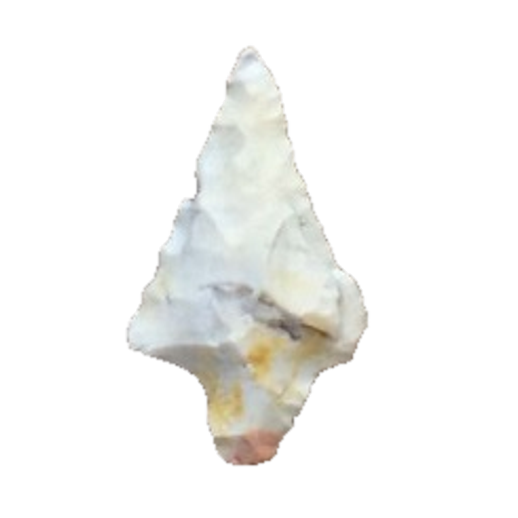
Arrowhead type
Weeden Island Point
Weeden Island1,500 - 1,100 B.P.Late Woodland15 reference photos
Key facts
- Age
- 1,500 - 1,100 B.P.
- Cultural period
- Late Woodland
- Size
- Small
- Shape
- Contracting Stem
- Glacial period
- Roman to Medieval
More from the Woodland period
Description
This diminutive point, measuring between 1 to 2 inches in length, exhibits a triangular form with a contracting stem and an elliptical cross-sectional profile. The blade edge is predominantly straight, although it may exhibit a subtle incurvate curvature, particularly on specimens that have undergone re-sharpening. The shoulder morphology ranges from slightly barbed to moderately angled, with a tendency for the shoulders to become less pronounced as the point is re-sharpened. The stem tapers slightly, while the base displays variability, ranging from a straight to a convex shape, with basal corners that are consistently rounded. The flaking pattern on this point is characterized by a random, non-directional arrangement of flakes.
Size
The dimensions of the arrowheads are as follows: they range in overall length from 30 to 55 mm, with stem lengths varying between 8 and 13 mm. The width of the blade spans 18 to 28 mm, while the stem width measures between 7 and 13 mm.
Distribution
This type is mainly discovered in the shoreline areas of western central and northern Florida, extending into southern Georgia and southeast Alabama
Additional information
In the realm of Native American archaeology, a particular type of arrowhead has garnered significant attention due to its distinctive characteristics and cultural associations. This point, classified as a variant of the Duvall type, exhibits a notable trait: it is often re-sharpened, resulting in a spike-like appearance. This re-sharpening process, observed by researchers such as Granger and Granger (2013), underscores the resourcefulness and practicality of the indigenous peoples who crafted these points.
The nomenclature of this point has undergone an evolution, reflecting the complexities of archaeological classification. Initially, Bullen referred to this point as the Cooley point, based on examples from Brad Colley's collection, as reported by Schroder (2012). However, subsequent research led to a redesignation, with the point becoming associated with the Weeden Island culture, from which it derives its current name. Interestingly, Son Anderson employs an alternative terminology, referring to these points as Safety Harbor Stemmed points, highlighting the nuanced and multifaceted nature of archaeological classification.
The Weeden Island point, with its re-sharpened spike-like appearance, offers valuable insights into the lives and traditions of the Native American communities that created it. Through the study of such artifacts, researchers can reconstruct the technological, social, and cultural contexts in which they were crafted and utilized. As a variant of the Duvall type, the Weeden Island point represents a significant component of the archaeological record, providing a window into the past and inviting further exploration and analysis of the complex and fascinating history of Native American cultures.
Identified by
- Named by
- Ripley P. Bullen
- Year
- 1956
- Type site
- Jim Woodruff Reservoir, Florida
Similar types
Types that are easy to confuse with the Weeden Island point.