
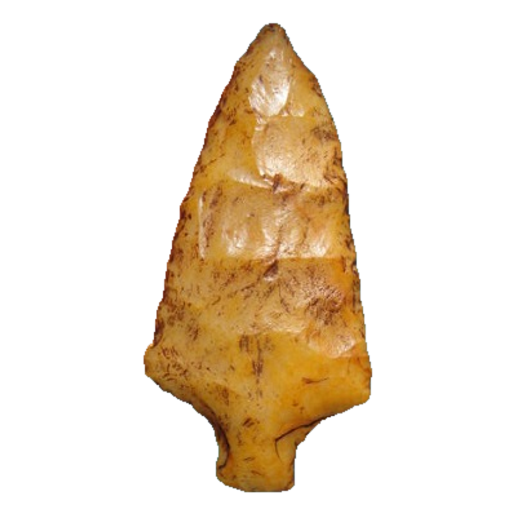
Arrowhead type
Cottonbridge Point
Cottonbridge6,000 - 4,500 B.P.Middle Archaic12 reference photos
Key facts
- Age
- 6,000 - 4,500 B.P.
- Cultural period
- Middle Archaic
- Size
- Medium to Large
- Shape
- Straight Stem
- Glacial period
- Middle Holocene
More from the Archaic period
Description
This stemmed point exhibits a broad, medium to large size profile, characterized by an elliptical cross-sectional shape. The blade morphology ranges from slightly excurvate to incurvate, with some specimens displaying a recurvate form, where the blade edges flare outward at the shoulders. Asymmetry is a common feature, with one blade edge often being straighter than the opposing edge. The shoulders are typically angled upward and may also be asymmetrical. The stem is straight, with a base that can be either straight or slightly convex. Notably, the stem is often thick and features beveling along both edges of both faces, accompanied by crude basal thinning. The flaking pattern on this point is random, lacking a consistent or organized arrangement.
Size
The arrowheads exhibit a range of dimensions, with overall lengths spanning 40 to 77 mm. The stem, a crucial component, measures between 7 and 14 mm in length, with an average length of 11 mm. In terms of width, the arrowheads vary from 34 to 52 mm, while the stem width ranges from 9 to 20 mm, averaging 17 mm. The thickness of these artifacts falls within a narrow range of 10 to 13 mm.
Distribution
This type is mainly located in the southeastern region of Alabama, extending into southern portions of Georgia and northern areas of Florida.
Additional information
In the realm of Native American arrowhead typology, the Cottonbridge point has garnered significant attention. Initially designated as "Cotton Bridge" by Ralph Allen in 1989, the nomenclature has since undergone a subtle modification, with "Cottonbridge" emerging as the prevailing term. Notably, this point type bears a striking resemblance to the Abbey type, sharing a comparable geographic distribution and exhibiting many analogous characteristics. A closer examination, however, reveals distinct differences between the two types. The Cottonbridge point is distinguished by its straight to excurvate blade configuration, which contrasts with the recurvate blade typically associated with the Abbey type. Furthermore, the basal edge of the Cottonbridge point is characterized by a convex to rounded shape, whereas the Abbey type often features a straight basal edge, as observed by Granger and Granger in their 2013 research. These subtle yet significant variations underscore the importance of meticulous analysis in arrowhead classification, highlighting the complexities and nuances inherent to the study of Native American lithic technology.
Identified by
- Named by
- Ralph Allen
- Year
- 1989
Similar types
Types that are easy to confuse with the Cottonbridge point.
Other types in this cluster
- Boggy Branch