
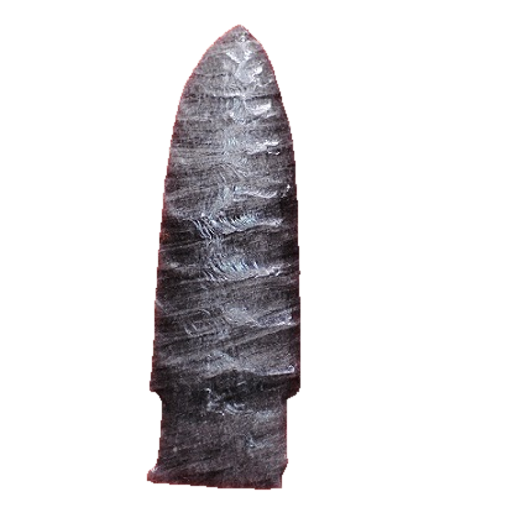
Arrowhead type
Eden Point
EdenPlano Stemmed Cluster9,250 - 8,850 B.P.Transitional Paleo to Early Archaic23 reference photos
Key facts
- Age
- 9,250 - 8,850 B.P.
- Cultural period
- Transitional Paleo to Early Archaic
- Culture
- Cody Complex
- Size
- Medium to Large
- Shape
- Straight Stem to Lanceolate
- Material
- Agate
- Glacial period
- Early Holocene
Description
This lanceolate-shaped point features a distinctive median ridge in cross-section and exhibits a slender, elongated profile. The blade's curvature is predominantly excurvate, characterized by a long, narrow shape. The shoulders are often subdued or barely perceptible, with a range of orientations from horizontal to slightly angled upwards. The stem is typically straight and rectangular, although some specimens display basal ears. The base of the point can vary in shape, ranging from straight to convex, and often features basal grinding. The manufacturing process involved serial pressure flaking, resulting in a symmetrical scar pattern that transitions from collateral to parallel, indicative of a carefully controlled flaking technique.
Size
The dimensions of the arrowheads are characterized by the following measurements: overall length ranges from 50 to 150 mm, with a typical length of 55 to 60 mm. The stem portion measures between 10 to 20 mm in length, averaging 15 mm, which corresponds to approximately 1/3 to 1/10 of the total length. The blade width spans 15 to 25 mm, with an average width of 17 to 20 mm. The stem width is narrower than the blade by 3 to 6 mm, averaging 14 to 19 mm.
Distribution
This style is typically discovered in Wyoming to Colorado and western Nebraska. They are abundant on the High Plains from New Mexico to Canada. They extend into Texas and Ontario. Justice (1987) observes that the Cody Complex is absent from the Ohio River valley, but similar specimens have been discovered resembling Cody Complex type points, but are generally classified as McConnell Lanceolate, Stringtown, and Ohio Stemmed type points.
Additional information
The Eden point, initially referred to as the Yuma point due to surface discoveries in Yuma County, Colorado, was later found in situ at the Finley site, prompting its renaming after the nearby town of Eden. Notably, the Eden point bears a resemblance to the Scottsbluff point, but its distinctive characteristics set it apart. Specifically, the Eden point features a narrow blade with weak shoulders, distinguishing it from its Scottsbluff counterpart. A key diagnostic feature of the Eden point is its cross-sectional median ridge, which imparts a diamond-shaped profile, a trait absent in the Scottsbluff type (Justice, 1987).
A comprehensive study conducted by Bradley and Stanford (1987) aimed to delineate the differences between Eden and Scottsbluff points. While many examples exhibited sufficient distinctiveness to be classified as either Eden or Scottsbluff, the researchers encountered numerous specimens that blurred the lines between the two types. This led them to propose that the Scottsbluff and Eden types may, in fact, represent a continuum of a single point type. They suggested that the re-sharpening process of Scottsbluff points could account for the development of the median ridge and reduced shoulders, which are crucial identifying features that distinguish Eden points from their Scottsbluff counterparts.
An interesting variation of the Eden point, characterized by the presence of "ears," has been exclusively identified in Wisconsin, as noted by Justice (1987). This regional specificity highlights the importance of considering geographic context in the analysis of archaeological artifacts. The Eden point's unique combination of characteristics, including its narrow blade, weak shoulders, and median ridge, underscores its significance in the study of Native American lithic technology and cultural exchange networks. By examining the nuances of point types like the Eden, researchers can gain a deeper understanding of the complexities and variations that exist within the broader context of Native American archaeological record.
Identified by
- Named by
- H. Maria Wormington
- Year
- 1957
- Type site
- Finley Bison Kill Site, Sweetwater, Wyoming
Similar types
Types that are easy to confuse with the Eden point.
- Agate Basin
- Alder
- Angostura
- Browns Valley
- Coryell
- Early Stemmed
- Firstview
- Hollenberg
- Kramer
- Nebo Hill
- San Jon
- Searcy
- Stone Square Stem
- Windust
Other types in the Plano Stemmed Cluster
- Alberta
- Cody Knife
- Holland
- Scottsbluff