
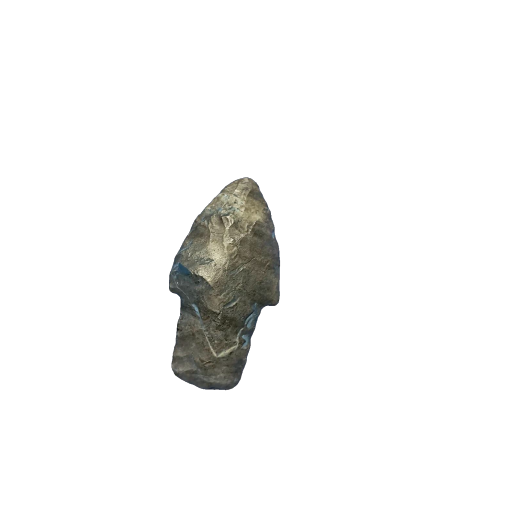
Arrowhead type
Alberta Point
AlbertaPlano Stemmed Cluster9,250 - 8,850 B.P.Transitional Paleo10 reference photos
Key facts
- Age
- 9,250 - 8,850 B.P.
- Cultural period
- Transitional Paleo
- Culture
- Cody Complex
- Size
- Medium to Large
- Shape
- Straight Stem
- Glacial period
- Early Holocene
More from the Paleo period
Description
Two distinct point types are characterized by their unique morphological features. The first is a compact, triangular point with a stemmed to expanding stem configuration, measuring between 1.25 and 1.75 inches in length. Its cross-sectional profile is flattened, with a straight-edged blade that tapers to a sharp apex. The stem is elongated and slightly widens towards the base, which can range from straight to mildly convex. The flaking pattern on this point is random and irregular.
In contrast, the second point type is a medium to large, lanceolate-shaped specimen with an elliptical cross section that is uniformly thick. The blade exhibits a pronounced excurvate curve, terminating in a blunted tip. The shoulders are typically horizontal and not well-defined. The stem is broad, elongated, and straight, with a length that exceeds its width. Although the stem is generally straight, it may occasionally flare or narrow slightly. The base of this point can vary from straight to mildly convex. A notable feature of this point is the presence of extensive grinding on the basal and lateral edges, indicative of hafting. The manufacturing process involves even percussion flaking, followed by a finishing technique that employs fine, long, and even pressure flaking, resulting in a parallel flaking pattern.
Size
The dimensions of the arrowheads are characterized by a total length ranging from 50 to 150 mm. The stem, which constitutes between 1/3 to 1/10 of the overall length, measures between 13 to 25 mm. In terms of width, the arrowheads span 25 to 45 mm, with the stem width specifically measuring between 20 to 30 mm, as outlined by Suhm and Krieger (1954).
Distribution
This type is typically discovered in the grasslands of Alberta and Saskatchewan, extending into the northern flat regions of the United States. It ranges westward to the eastern boundary of the Rocky Mountains, and also appears in the Oklahoma panhandle and as far north as Minnesota
Mainly found in
Also found, less often, in
Additional information
In the realm of Native American arrowheads, the Alberta point stands out as a distinct type, bearing similarities to the Scottsbluff point, yet exhibiting several notable differences. A key characteristic of the Alberta point is its large size, accompanied by a stem that is not only longer but also broader, and a tip that is often blunted (Drager and Ireland, 1986). The stem's elongated shape, where its length surpasses its width, serves as a crucial distinguishing feature from the Scottsbluff point, allowing archaeologists to accurately categorize these artifacts. Furthermore, Alberta points tend to be thicker and display less refined pressure flaking compared to their Scottsbluff counterparts, as observed by Morrow in 2016. This intermediate design, situated between the characteristics of Hell Gap and Scottsbluff points, underscores the complexity and diversity of Native American arrowhead craftsmanship.
The distinction in stem dimensions and the presence of a blunted tip are essential factors in identifying Alberta points, highlighting the meticulous attention to detail required in archaeological classification. The thickness of Alberta points, combined with their less refined pressure flaking, suggests a unique manufacturing approach, potentially reflecting the technological or stylistic preferences of the cultures that created them. By examining these characteristics, researchers can gain insights into the cultural and historical contexts in which these arrowheads were produced and used.
The intermediate design of Alberta points, bridging the characteristics of Hell Gap and Scottsbluff points, is a significant aspect of their morphology. This design suggests a potential chronological or geographical relationship between these point types, with Alberta points possibly representing a transitional phase or a regional variation. As archaeologists continue to study and compare these artifacts, they may uncover further evidence of the complex interactions and exchanges between Native American groups, shedding light on the dynamic and evolving nature of their technological and cultural practices.
Identified by
- Named by
- H. Maria Wormington
- Year
- 1957
Similar types
Types that are easy to confuse with the Alberta point.
Other types in the Plano Stemmed Cluster
- Cody Knife
- Eden
- Holland
- Scottsbluff