
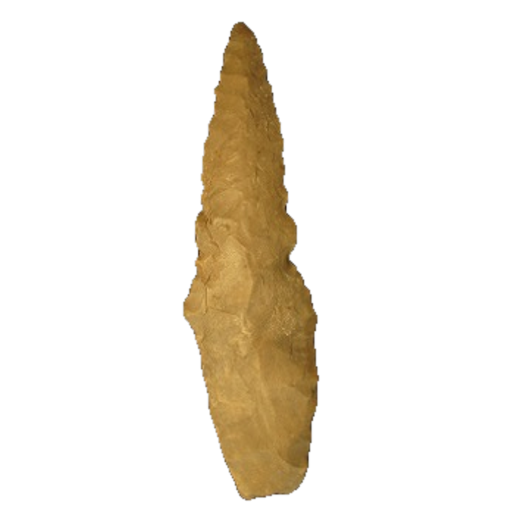
Arrowhead type
Coryell Point
Coryell7,000 - 5,000 B.P.Early Archaic to Middle Archaic4 reference photos
Key facts
- Age
- 7,000 - 5,000 B.P.
- Cultural period
- Early Archaic to Middle Archaic
- Size
- Medium
- Shape
- Straight Stem to Contracting Stem
- Glacial period
- Middle Holocene
More from the Archaic period
Description
This stemmed point exhibits a medium-sized, lanceolate silhouette with an elliptical profile. The blade's curvature is predominantly excurvate, although heavy re-sharpening can cause the edge to broaden at the shoulder junction. Serrations are typically present just above the hafting area, and beveling is a common feature. The shoulders are often subdued or absent, sloping upward, but can also occur as horizontal or slightly barbed. The stem's morphology is generally straight, with some variability, ranging from slightly expanding to slightly contracting. The base of the point is usually straight, although it can also be slightly concave. The hafting region frequently displays evidence of grinding. The flaking pattern on this point is characterized by a random arrangement of flakes.
Size
The arrowhead's dimensions are characterized by a total length ranging from 75 to 100 mm. The stem, which constitutes approximately one-third of the overall point length, measures between 25 and 35 mm. The blade's width spans 23 to 40 mm, while the stem's width at the shoulder junction ranges from 20 to 30 mm. At its base, the width varies between 15 and 25 mm.
Distribution
This type is mainly discovered in Coryell County and adjacent areas in central Texas and extending into eastern Texas
Mainly found in
Additional information
The origins of this particular arrowhead type have been attributed to Dwain Rogers, who is credited with its naming. However, a thorough review of his published works has yielded no mention of this specific point. Notably, Rogers conducted extensive research on Corner Notch Knives in Texas, publishing his findings in 1999, but this point was not included in his study. Instead, it was Gregory Perino who referenced this point in 2003, initially identifying it as a Texas Kirk type. Nevertheless, further examination has revealed that this classification is not entirely accurate. A more plausible interpretation suggests that this point may represent a geographic extension of the Searcy type, broadening our understanding of its distribution and highlighting the complexities of arrowhead typology in the region.
The Searcy type, as a distinct category, has been the subject of ongoing research and refinement. The fact that this point may be an extension of this type underscores the importance of continued study and classification of arrowhead types. By reevaluating the distribution and characteristics of these artifacts, archaeologists can gain a deeper understanding of the cultural and historical contexts in which they were created and used. The work of researchers like Dwain Rogers and Gregory Perino has laid the groundwork for further investigation, and it is through this process of scholarly inquiry that our knowledge of Native American arrowheads continues to evolve.
The lack of clear documentation from Dwain Rogers regarding this point serves as a reminder of the complexities and challenges inherent in archaeological research. Despite the absence of a direct publication link, the cumulative efforts of researchers have ultimately shed light on the probable identity and significance of this arrowhead type. As our understanding of the Searcy type and its distribution expands, so too does our appreciation for the intricate cultural landscape of Native American communities, highlighting the value of meticulous research and collaboration in the field of archaeology.
Identified by
- Named by
- Dwain Rogers
Similar types
Types that are easy to confuse with the Coryell point.