
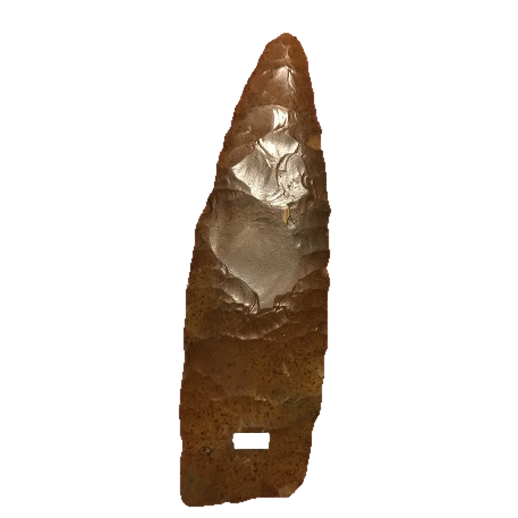
Arrowhead type
Cody Knife
Cody Knife9,250 - 8,850 B.P.Transitional Paleo to Early Archaic18 reference photos
Key facts
- Age
- 9,250 - 8,850 B.P.
- Cultural period
- Transitional Paleo to Early Archaic
- Culture
- Cody culture
- Size
- Medium
- Shape
- Ovoid to Other
- Glacial period
- Early Holocene
Description
This artifact exhibits a medium-sized, asymmetric knife morphology, characterized by a blade that can display a range of curvature, from straight to distinctly excurvate. When shoulders are present, they tend to be subdued and not prominently defined. The stem is typically straight, terminating in a base that is also straight. Notably, the overall appearance of this knife can vary significantly depending on the specific manufacturing techniques employed, yet its fundamental characteristics remain consistent, namely, an asymmetrical configuration and a diagonal orientation of the blade.
Size
Medium
Distribution
This projectile is predominantly discovered in Canada and the northern grasslands. It can also be located in the northwestern region and as far south as Texas, as well as northeastern Chihuahua, northern Coahuila, northern Nuevo Leon, and the northernmost part of Tamaulipas, Mexico. Often found alongside Eden and Scottsbluff points, with numerous examples sharing a similar geographic range as the Scottsbluff point
Mainly found in
Also found, less often, in
Additional information
More information needed.
Identified by
- Named by
- H. Maria Wormington
- Year
- 1957
- Type site
- =
Similar types
Types that are easy to confuse with the Cody Knife point.
- Base Tang Knife
- Corner Tang Knife
- Firstview
- Red River Knife