
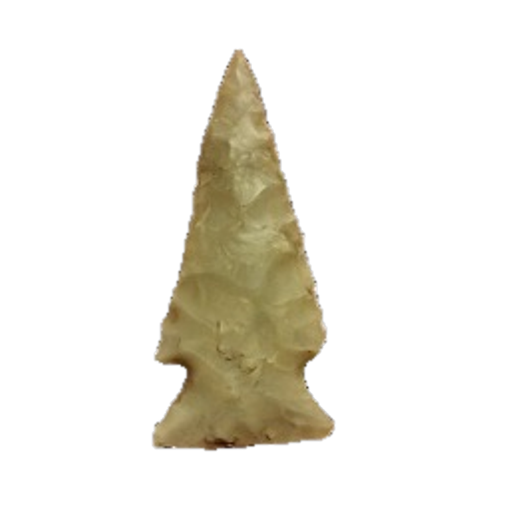
Arrowhead type
Early Stemmed Point
Early Stemmed9,000 - 8,000 B.P.Transitional Paleo to Early Archaic2 reference photos
Key facts
- Age
- 9,000 - 8,000 B.P.
- Cultural period
- Transitional Paleo to Early Archaic
- Size
- Medium to Large
- Shape
- Expanding Stem to Corner Notch
- Glacial period
- Early Holocene
Description
This expansive stem point exhibits a medium to large size profile, characterized by an elliptical cross-sectional shape. The blade morphology can range from gently curved to straight-edged, often displaying beveled edges resulting from repeated resharpening. The shoulder morphology is variable, spanning from pronounced barbs to angled terminations that slope upward. The stem itself can be either parallel-sided or expanding, while the base is generally straight, although it may occasionally exhibit a slight convex or concave curvature. Evidence of grinding is apparent on both the stem and base. The flaking pattern on this point is characterized by a random, non-patterned arrangement of flakes.
Size
The dimensions of the arrowheads are as follows: they exhibit a total length ranging from 50 to 65 mm, with the stem portion measuring between 12 to 17 mm. The width of the blade spans 23 to 35 mm, while the neck width falls within the range of 15 to 20 mm. Additionally, the stem width is observed to be between 23 to 30 mm, noting that these measurements are derived from a limited dataset.
Distribution
This type is mainly located in the Pecos area and extends into south and central Texas. It can also be discovered in southern Oklahoma, albeit less commonly.
Additional information
In the realm of Native American archaeology, a particular type of arrowhead has been identified as belonging to the Transitional Paleo period, a timeframe characterized by significant cultural and technological shifts. Notably, this point has been discovered in conjunction with Golondrina points, a finding that underscores its temporal affiliation (Turner and Hester, 1985). The co-occurrence of these two point types provides valuable insights into the lives and traditions of the indigenous peoples who crafted them.
Further evidence of this point's cultural significance can be gleaned from its presence at the Wilson Leonard site, located in Bell County, Texas. Here, archaeologists have unearthed examples that have been specifically designated as Wilson points, a classification that highlights their unique characteristics and associations (Turner and Hester, 1985). The Wilson Leonard site has yielded a wealth of information about the lives and activities of the people who inhabited this region, and the discovery of these points has contributed significantly to our understanding of the Transitional Paleo period.
The classification of these points as Wilson points, based on their discovery at the Wilson Leonard site, serves as a testament to the meticulous work of archaeologists in documenting and analyzing the material culture of Native American communities. By examining the characteristics and distribution of these points, researchers can reconstruct the technological, social, and cultural contexts in which they were created and used, ultimately deepening our appreciation for the complexity and diversity of indigenous cultures in North America during the Transitional Paleo period.
Identified by
- Named by
- Elias H. Sellards and Glen L. Evans
- Year
- 1940
- Type site
- Berclair Terrace, Bee County, Texas
Similar types
Types that are easy to confuse with the Early Stemmed point.