
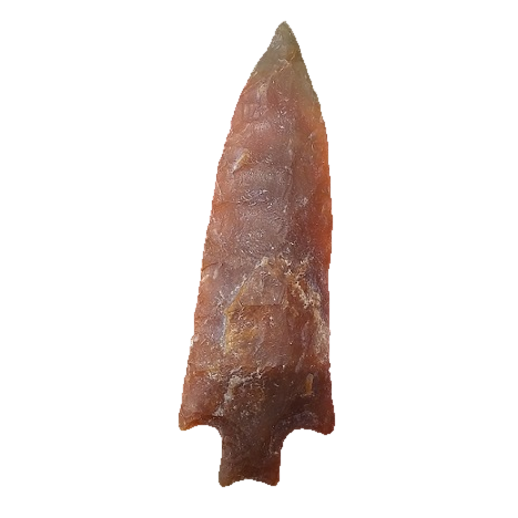
Arrowhead type
Sarasota Point
SarasotaLowe Cluster to Steuben Cluster3,000 - 1,500 B.P.Woodland9 reference photos
Key facts
- Age
- 3,000 - 1,500 B.P.
- Cultural period
- Woodland
- Culture
- Belle Blades to Weeden Island II
- Size
- Medium
- Shape
- Expanding Stem to Straight Stem
- Glacial period
- Neoglacial to Roman Warm
More from the Woodland period
Description
This triangular point exhibits a size range of 2.5 to 4.5 inches, characterized by an elliptical cross-sectional profile. The blade morphology is predominantly excurvate, although some specimens may display a straight configuration. The shoulder orientation varies from a horizontal alignment to a subtle, upward inclination. The stem tapers outward slightly, terminating in a base that is either straight or mildly convex. The flaking pattern observed on this point is random, lacking a discernible, organized arrangement.
Size
The arrowhead's dimensions are as follows: it measures between 60 and 115 mm in overall length, with a stem length ranging from 10 to 15 mm. The blade itself spans 25 to 50 mm in width, while the neck and basal widths are 13 to 19 mm and 16 to 21 mm, respectively. In terms of thickness, the arrowhead ranges from 7 to 13 mm.
Distribution
This type is mainly located in Florida and extends into the southern regions of Georgia and Alabama.
Also found, less often, in
Additional information
In a comparative analysis of Native American arrowhead types, the Sarasota point exhibits notable similarities to the Columbia point. However, as highlighted by Bullen in 1975, a key distinguishing feature between these two types lies in the proportional relationship between the blade width and the stem width, specifically at the shoulder. A distinctive characteristic of the Sarasota point is its broader shoulder, which yields a blade to stem ratio ranging from 1.8:1 to 1.5:1. This translates to a stem width that is approximately 50% of the blade width, setting it apart from other point types.
In contrast, the Columbia point displays a more compact shoulder, with a blade to stem width ratio of 1.2:1 to 1.3:1. This indicates that the stem width of the Columbia point is roughly 80% of the blade width, underscoring a significant difference in the morphometric proportions of these two arrowhead types. The variation in these ratios not only aids in the identification and classification of these points but also provides valuable insights into the technological and cultural preferences of the populations that crafted them.
The differences in blade to stem ratios between the Sarasota and Columbia points may reflect distinct functional or stylistic priorities, highlighting the diversity of technological traditions among Native American groups. By examining these subtle yet significant variations, archaeologists can gain a deeper understanding of the cultural and historical contexts in which these arrowheads were produced and used, ultimately enriching our knowledge of the complex and nuanced histories of Native American communities.
Identified by
- Named by
- Ripley P. Bullen
- Year
- 1951
- Type site
- Sarasota County Mound, Sarasota County, Florida
Similar types
Types that are easy to confuse with the Sarasota point.