
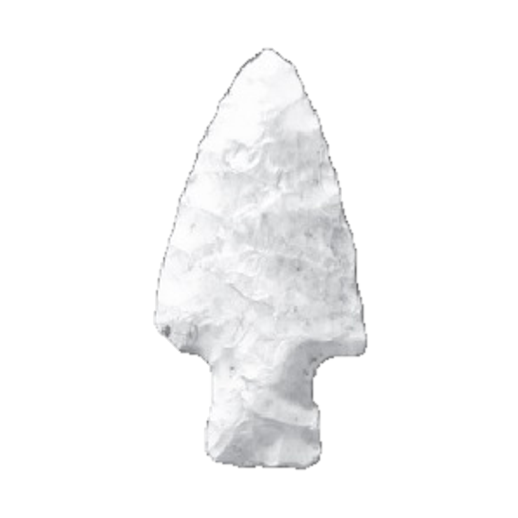
Arrowhead type
Kampsville Point
KampsvilleTerminal Archaic Barbed Cluster2,900 - 2,500 B.P.Late Archaic to Early Woodland7 reference photos
Key facts
- Age
- 2,900 - 2,500 B.P.
- Cultural period
- Late Archaic to Early Woodland
- Size
- Medium to Large
- Shape
- Straight Stem to Expanding Stem to Basal Notch to Corner Notch
- Glacial period
- Neoglacial
Description
This triangular point features a stemmed design with an elliptical profile, showcasing a distinctive excurvate blade shape that often curves inward at the shoulders, although repeated sharpening can result in a straighter edge. The shoulders themselves are typically barbed, sometimes extending halfway or even the full length of the stem, but tend to become less pronounced as the point is re-sharpened. The stem's shape can vary, ranging from straight to slightly flared, with a base that may be straight or mildly convex. The basal corners exhibit a range of sharpness, from acute to rounded. In terms of manufacture, the point was created using a combination of techniques, with random percussion flaking employed for the initial shaping, followed by pressure flaking to refine the blade's edge, yielding a characteristic random flaking pattern.
Size
The arrowheads exhibit dimensions within the following ranges: length spans from 20 to 33 mm, while the blade width varies between 10 and 15 mm, and the thickness measures between 2 and 4 mm.
Distribution
This type is mainly discovered in the southern Illinois River Valley and extending into Missouri.
Additional information
More information needed.
Identified by
- Named by
- Gregory Perino
- Year
- 1968
- Type site
- Kampsville Site, Calhoun County, Illinois
Similar types
Types that are easy to confuse with the Kampsville point.
Other types in the Terminal Archaic Barbed Cluster
- Buck Creek
- Bulverde
- Delphi
- Smithsonia
- Wade