
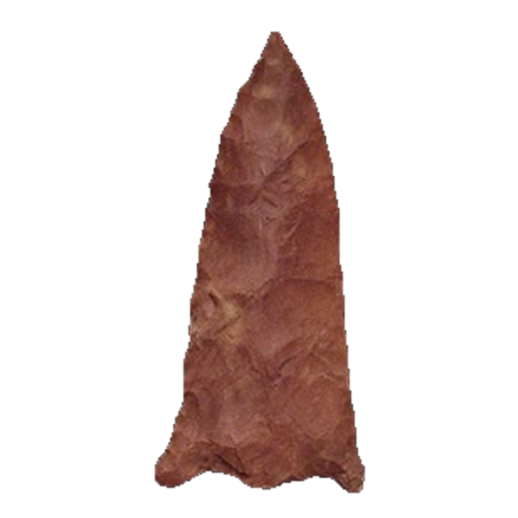
Arrowhead type
Eva Point
EvaEva Cluster7,500 - 6,000 B.P.Early Archaic18 reference photos
Key facts
- Age
- 7,500 - 6,000 B.P.
- Cultural period
- Early Archaic
- Size
- Medium to Large
- Shape
- Basal Notch
- Glacial period
- Early Holocene
More from the Archaic period
Description
This triangular point exhibits a medium to large size range, characterized by a cross-sectional profile that transitions from flat to slenderly elliptical. The blade's curvature is typically outward, although instances of inward curvature are also observed. The presence of basal notches imparts a barbed appearance to the shoulders, which can become less pronounced as the point undergoes repeated re-sharpening. A distinctive stem, formed by two notches at the base, can be straight or tapering, and may exceed the length of the barbs. The base itself can display a range of shapes, from straight to mildly convex, and may feature evidence of basal grinding or thinning. The manufacturing process involves initial broad percussion flaking, followed by finer, more precise percussion flaking that yields a random pattern of flake scars. In some cases, the blade may be re-touched using fine pressure flaking, further refining its edge.
Size
The arrowhead's dimensions are as follows: it has a total length ranging from 48 to 96 mm, with an average of 61 mm. The stem measures between 5 and 7 mm in length, averaging 6 mm. The blade width varies from 25 to 39 mm, with a mean width of 33 mm. The stem width ranges from 11 to 36 mm, averaging 18 mm. In terms of thickness, the arrowhead measures between 8 and 10 mm.
Distribution
This type is predominantly located in the western region of Tennessee, specifically within the Tennessee River basin. Its presence dwindles in the eastern part of the basin. It occasionally appears in the central to northern sections of the Ohio River basin, and sporadically in western Virginia, North Carolina, South Carolina, and Georgia
Additional information
In the realm of Native American archaeology, the Eva point is a significant artifact that has been extensively studied. Notably, two distinct forms of the Eva point have been identified: Eva Type I and Eva Type II. The earlier form, Eva Type I, is characterized by a shorter, contracting stem, and tends to be larger in size compared to its counterpart, Eva Type II (Justice, 1987). In contrast, Eva Type II points are distinguished by their longer barbs and stems that range from straight to rounded.
A comprehensive analysis of the Morrisroe Site in Livingston County, Kentucky, conducted by Lewis and Lewis (1961), shed further light on the Eva point variants. Their research revealed four distinct types, with the first two corresponding to Eva Type I and Eva Type II. The remaining two variants were designated as Cypress Creek Type I and Cypress Creek Type II. However, it is worth noting that the latter, Cypress Creek Type II, was not thoroughly described in their study, as observed by Nance (1986). This omission highlights the need for continued research and documentation of these archaeological artifacts to gain a deeper understanding of their significance and cultural context.
The study of Eva points and their variants provides valuable insights into the technological and cultural developments of Native American communities. The variations in stem shape, barb length, and overall size of these points reflect the adaptability and ingenuity of their creators. As archaeologists continue to examine and interpret these artifacts, they can gain a more nuanced understanding of the historical and cultural contexts in which they were crafted and used. By exploring the characteristics and distributions of Eva points, researchers can reconstruct the lives and traditions of the people who created them, ultimately enriching our understanding of Native American history and culture.
Identified by
- Named by
- T.M.N Lewis and Madeline Kneberg
- Year
- 1955
- Type site
- Eva Site, Benton County, Tennessee
Similar types
Types that are easy to confuse with the Eva point.
Other types in the Eva Cluster
- Cypress Creek
- Morrow Mountain