
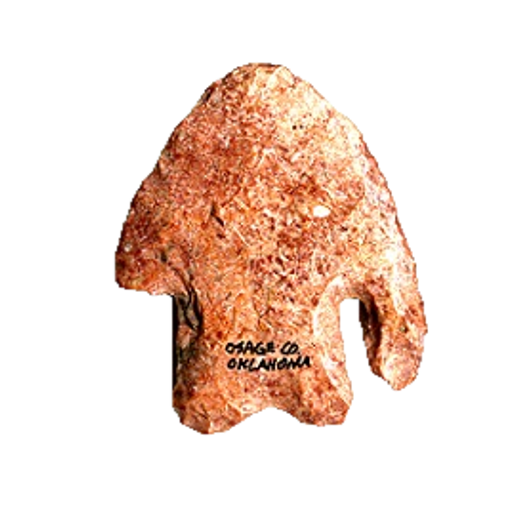
Arrowhead type
Calf Creek Point
Calf CreekThebes Cluster5,400 - 4,500 B.P.Middle Archaic10 reference photos
Key facts
- Age
- 5,400 - 4,500 B.P.
- Cultural period
- Middle Archaic
- Size
- Medium to Large
- Shape
- Basal Notch
- Material
- Chert
- Glacial period
- Middle Holocene
More from the Archaic period
Description
This triangular basal notch point exhibits a size range of 1.5 to 4.75 inches, with an average length of 2 inches. Its cross-sectional profile is characterized by a thin, flattened to elliptical shape, with finer materials typically yielding thinner specimens and coarser materials resulting in thicker ones. The blade morphology varies from excurvate to straight, and in heavily resharpened examples, it may assume a pentagonal form. Serrations are also present on some blades. The base of the point features long, narrow notches that give rise to a shoulder with elongated, drooping barbs, which often extend to the base of the point; these barbs can be either square or rounded in shape. The stem displays a range of forms, from straight to slightly expanding, while the base ranges from straight to slightly convex. Both the base and stem exhibit evidence of smoothing and grinding. The point's manufacture involves an initial stage of rough percussion flaking, followed by a finishing stage of fine pressure flaking, which frequently produces fine serrations. The overall flaking pattern on this point is random.
Size
The dimensions of the arrowheads are characterized by a total length ranging from 54 to 110 mm, with a mean length typically falling between 55 to 60 mm. The stem itself measures between 10 to 20 mm in length. In terms of width, the arrowheads span from 35 to 55 mm, with an average width of 45 mm. Furthermore, the stem width is observed to be between 20 to 30 mm.
Distribution
These artifacts are predominantly discovered in Arkansas, eastern Oklahoma, eastern Kansas, and Missouri. They are also commonly located in southern Indiana and southern Illinois
Additional information
In the realm of Native American arrowheads, certain examples exhibit extreme re-sharpening, which can result in the loss of distinctive features, including the long barbs that are typically characteristic of these artifacts. Notably, the point in question bears a resemblance to the Lost Lake point, a type identified by Justice in 1987. However, a key distinguishing feature sets these two point types apart: whereas the Lost Lake point is marked by barbs that terminate in a sharp point, the point under discussion is recognizable by its long, drooping barbs. This subtle yet significant difference highlights the importance of careful examination and classification in the study of arrowhead typology.
Identified by
- Named by
- Donald R. Dickson
- Year
- 1968
- Type site
- Calf Creek Cave, Searcy County, Arkansas
Similar types
Types that are easy to confuse with the Calf Creek point.
- Andice
- Bell
- Castroville
- Eva
- Furr
- Mehlville
- Ocala