
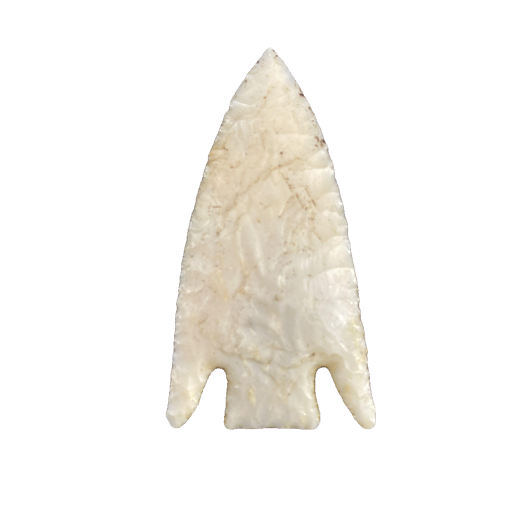
Arrowhead type
Smith Point
SmithEtley Cluster6,000 - 4,000 B.P.Middle Archaic18 reference photos
Key facts
- Age
- 6,000 - 4,000 B.P.
- Cultural period
- Middle Archaic
- Size
- Large
- Shape
- Basal Notch
- Glacial period
- Middle Holocene
More from the Archaic period
Description
This triangular basal notch point exhibits a substantial to very large size, characterized by a flattened profile. The blade's morphology is predominantly excurvate, with a notable curvature, particularly at the distal end, while the lateral edges tend to converge, becoming nearly parallel. In some instances, the blade assumes an outward recurvate configuration, whereas heavily re-sharpened specimens may display a subtle incurve shape. The notches, which originate from the base, form elongated barbs that typically extend to the base of the point, creating a distinctive silhouette. The stem is generally straight, while the base is usually straight, although some examples exhibit a mildly convex base. The point's fabrication involves broad percussion flaking, supplemented by limited pressure flaking, which is employed to re-touch the blade, resulting in a random, non-patterned flaking arrangement.
Size
The dimensions of the arrowheads are characterized by the following measurements: overall length ranges from 55 to 150 mm, with a typical average length of 65 to 85 mm. The stem measures between 10 to 16 mm in length. The blade width varies from 40 to 80 mm, averaging between 45 to 55 mm. At the shoulders, the stem width is recorded as 15 to 20 mm. In terms of thickness, the arrowheads measure between 8 to 10 mm.
Distribution
This type is mainly concentrated in Oklahoma, Arkansas, and Missouri. Its presence is somewhat less common in Texas and Louisiana. It also appears with reduced regularity in the Ohio River Valley and the Tennessee River Valley
Mainly found in
Additional information
In the realm of Native American archaeology, the classification of certain arrowhead types has been a subject of interest. Notably, the Stone Square Stem and Barry Square Stem points, as designated by Marshall, have been the focus of discussion. These point types, initially identified through a comprehensive study, have been reevaluated in terms of their characteristics and potential evolution. It is proposed that both the Stone Square Stem and Barry Square Stem points may, in fact, represent Smith type points that have undergone various degrees of re-sharpening. This process of re-sharpening can significantly alter the original morphology of the point, to the extent that distinctive features, such as the shoulders, become obscured. As observed by Ray in 2010, these modified points often co-occur with unaltered Smith points, suggesting a potential connection between the two forms. This association highlights the complex and dynamic nature of Native American tool production and use, where the reuse and reworking of existing materials were common practices.
Identified by
- Named by
- David A. Barrels and Joan Freeman
- Year
- 1960
- Type site
- Bluff Shelter, Delaware County, Oklahoma
Similar types
Types that are easy to confuse with the Smith point.