
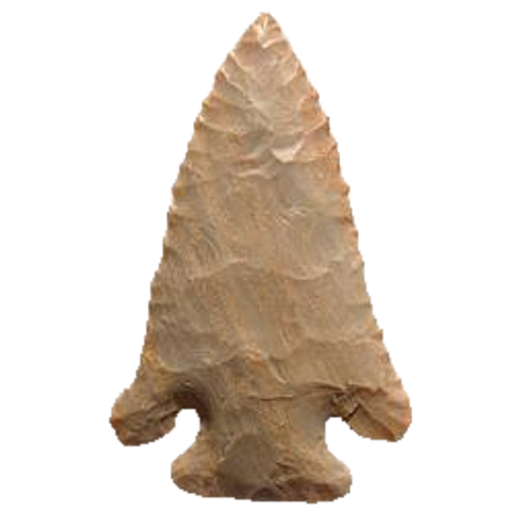
Arrowhead type
Lost Lake Point
Lost LakeThebes Cluster9,500 - 8,500 B.P.Early Archaic30 reference photos
Key facts
- Age
- 9,500 - 8,500 B.P.
- Cultural period
- Early Archaic
- Size
- Medium to Large
- Shape
- Corner Notch
- Glacial period
- Early to Middle Holocene
More from the Archaic period
Description
This triangular corner notch point exhibits a size range of 1.5 to 4.5 inches, characterized by a distinctive combination of flaking patterns and physical attributes. The cross-sectional profile can vary from elliptical to rhomboid, particularly in specimens that have undergone extensive re-sharpening and beveling. The blade's curvature ranges from excurvate to incurvate, with a notable feature being the beveling on one edge of each face, resulting in a serrated edge. The shoulders are marked by barbed morphology, often displaying a rounded contour, while the terminal end of the barb can exhibit either a rounded or square shape. The stem's expansion can vary, ranging from minimal to pronounced expansion. The base of the point can be either concave or convex and is typically thinned through the removal of shallow, broad flakes, with many examples showing evidence of grinding. The point's manufacture involves broad, shallow percussion flaking, supplemented by fine secondary pressure flaking along the edges, yielding a random flaking pattern. Overall, the workmanship is of high quality, with a strong emphasis on symmetry.
Size
The arrowheads exhibit the following dimensional characteristics: - Overall length ranges from 31 to 81 mm, with a mean length typically falling between 40 and 55 mm. - The stem length varies from 9 to 15 mm, averaging between 11 and 13 mm. - Blade width spans from 25 to 48 mm, with an average width of 30 to 40 mm. - The neck width measures between 14 and 20 mm. - Basal width ranges from 15 to 32 mm, averaging 21 to 27 mm. - Thickness ranges from 6 to 13 mm.
Distribution
These artifacts are predominantly discovered in Arkansas, eastern Oklahoma, eastern Kansas, and Missouri. This type can also be located in the Ohio River Valley, Tennessee River Valley, and extending into the Gulf Coastal area
Additional information
In the realm of Native American arrowhead typology, the point in question has been categorized by Justice as part of the Thebes cluster. However, Whatley's 2002 analysis suggests an alternative classification, positioning it as a variant within the Kirk Corner Notch cluster. A notable characteristic of these points is their frequent re-sharpening, which can significantly alter their morphology. Initially, the blade exhibits an excurvate shape, but as it undergoes re-sharpening, it tends to become more incurvate or even recurvate.
The process of re-sharpening also imparts distinct features on the blade, including beveling and serration. Furthermore, the shoulders of the point may undergo reduction or even become absent altogether, particularly when subjected to extensive re-sharpening, as observed by Granger and Granger in their 2013 study. This transformation underscores the dynamic nature of these artifacts, which were often reworked and reused by their creators to extend their functional lifespan. By examining the effects of re-sharpening on these points, researchers can gain valuable insights into the technological and cultural practices of the Native American groups that crafted them.
The re-sharpening patterns and resulting morphological changes in these arrowheads offer a fascinating window into the lives and adaptive strategies of their makers. As archaeologists, recognizing and interpreting these characteristics is essential for accurately dating and contextualizing these artifacts within their cultural and historical frameworks. By considering the complex interplay between the point's original form, its subsequent re-sharpening, and the cultural context in which it was used, researchers can reconstruct a more nuanced understanding of the technological, social, and economic dynamics that shaped the lives of Native American communities.
Identified by
- Named by
- David DeJarnette
- Year
- 1962
- Type site
- Stanfield-Worley Buff Shelter, Colbert County, Alabama
Similar types
Types that are easy to confuse with the Lost Lake point.
- Bolen
- Charleston
- Cypress Creek
- Hardin
- Kirk Corner Notch
- Pine Tree Corner Notch