
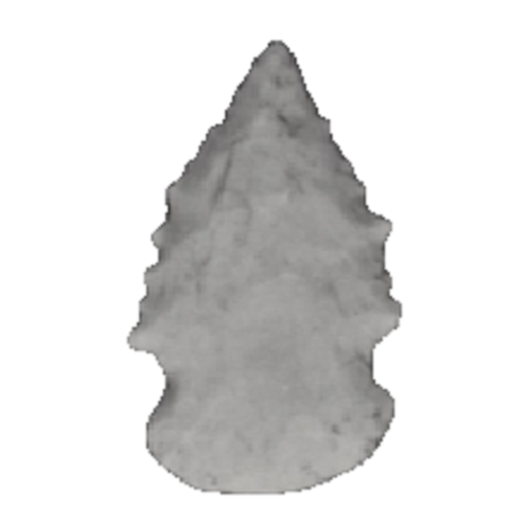
Arrowhead type
Cossatot River Point
Cossatot River4,500 - 2,200mB.P.Middle Archaic to Late Archaic7 reference photos
Key facts
- Age
- 4,500 - 2,200mB.P.
- Cultural period
- Middle Archaic to Late Archaic
- Size
- Medium to Large
- Shape
- Expanding Stem to Bifurcated
- Glacial period
- Neoglacial to Roman Warm
More from the Archaic period
Description
This triangular point exhibits a medium to large size, characterized by an elliptical cross-sectional profile. The blade morphology ranges from straight to excurvate, with some specimens displaying serrations along the cutting edge. The shoulders, formed by notches that originate from the blade's corners, can be slightly to deeply barbed. The stem's shape varies from slightly expanding to more pronounced expansion, and its base often features a shallow, central basal notch, although this trait is not universally present. The stem is elongated, with rounded basal corners that impart a bulbous appearance, and some examples may exhibit a bifurcated form. Basal grinding is a common feature of this point type. The flaking pattern on this point is random, lacking a consistent or organized arrangement. The overall combination of these characteristics, including the presence of basal grinding and variable stem and blade morphologies, defines this distinctive point type.
Size
The dimensions of the arrowheads are as follows: they range in overall length from 35 to 65 mm, with stem lengths spanning 10 to 15 mm. The width of the blade varies between 23 and 33 mm, while the neck width falls within the range of 15 to 25 mm. Additionally, the stem width is measured between 16 and 26 mm.
Distribution
This type is mainly discovered in Arkansas, eastern Oklahoma, and southeastern Missouri. It appears with less regularity in Illinois and northeastern Texas. Such specimens are seldom encountered in Louisiana.
Additional information
In his 1976 publication, Perino identified two distinct forms of arrowhead points, each with unique characteristics. Type A points are distinguished by their convex base, which is rounded at the basal corners, resulting in a bulbous shape. This distinctive form is a notable feature of Type A points. In contrast, Type B points exhibit a shallow basal notch, a trait that has led to their common identification as Cossatot River points. The differentiation between these two types highlights the diversity of arrowhead designs, underscoring the importance of meticulous classification in understanding the technological and cultural developments of Native American communities. By recognizing these variations, researchers can gain valuable insights into the craftsmanship, trade networks, and cultural exchange that shaped the lives of indigenous peoples.
Identified by
- Named by
- Gregory Perino
- Year
- 1976
Similar types
Types that are easy to confuse with the Cossatot River point.