
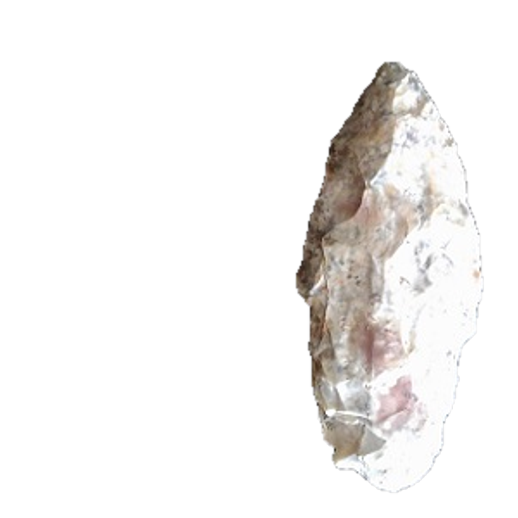
Arrowhead type
Silver Lake Point
Silver LakeGreat Basin Stemmed Cluster11,000 - 7,500 B.P.Transitional Paleo12 reference photos
Key facts
- Age
- 11,000 - 7,500 B.P.
- Cultural period
- Transitional Paleo
- Culture
- Western Stemmed Tradition
- Size
- Small to Medium
- Shape
- Straight Stem to Expanding Stem
- Glacial period
- Late Pleistocene to Early Holocene
More from the Paleo period
Description
This lanceolate point exhibits a distinctive morphology, characterized by a tapering stem and an elliptical cross-sectional profile. The blade itself displays a predominantly excurvate to straight trajectory, often accompanied by a compact, stubby appearance. The shoulders are either faint or nonexistent, sloping upward in a subtle incline. In contrast to other point types, such as the Lake Mohave point, the stem of this specimen is notably shorter and sometimes assumes a more rounded, bulbous form. Certain examples may feature faint, shallow indentations on the stem, which can impart a subtle, pseudo-notch-like appearance when viewed from the side. The basal edge is marked by a convex curve, while the hafting area bears evidence of intense grinding. Although the stem may exhibit thinning in certain areas, the base of the point remains unthinned. The flaking pattern observed on this point is characterized by a random, non-directional arrangement of flakes.
Size
The dimensions of the arrowheads are characterized by the following measurements: overall length ranges from 26 to 66 mm, while the stem length spans 15 to 28 mm, generally comprising between one-third to one-half of the total length. The blade width measures between 21 and 37 mm, and the stem width falls within the range of 14 to 22 mm. In terms of thickness, the arrowheads exhibit a range of 6 to 11 mm.
Distribution
This type exhibits a comparable geographic range to the Lake Mohave point, but with a greater prevalence in southern California and the southern portion of the Great Basin. It is also discovered in northern Baja California, at the La Playa site in Sonora, and northern Chihuahua, Mexico
Mainly found in
Additional information
In the realm of Native American arrowhead typology, the Lake Mojave and Silver Lake types are two distinct categories that have been meticulously defined by Amsden. A key characteristic of the Lake Mojave type is its elongated, tapering stem, which is often accompanied by slight, narrow shoulders that may or may not be present. The overall shape of the Lake Mojave arrowhead tends to be diamond-shaped, with the stem typically exceeding the length of the blade. Interestingly, the form of the Lake Mojave type can vary, ranging from an oval shape to a more pronounced diamond shape.
In contrast, the Silver Lake type exhibits a more pronounced definition of the shoulder, setting it apart from the Lake Mojave type. Another notable difference lies in the stem length, with the Silver Lake type featuring a shorter stem that never exceeds half the length of the arrowhead and is usually approximately one-third of the overall length. Furthermore, the Silver Lake type is distinguished by its convex base, which provides a clear point of distinction from the Lake Mojave type.
The differentiation between these two types highlights the complexity and nuance of Native American arrowhead typology. By examining the subtle variations in shape, size, and form, archaeologists can gain valuable insights into the cultural and technological practices of the communities that created these artifacts. The Lake Mojave and Silver Lake types, in particular, demonstrate the diversity and richness of arrowhead design, reflecting the unique cultural and historical contexts in which they were crafted.
Identified by
- Named by
- Charles Amsden
- Year
- 1937
- Type site
- Lake Mohave Site
Similar types
Types that are easy to confuse with the Silver Lake point.
Other types in the Great Basin Stemmed Cluster
- Crescent
- Cougar Mountain
- Lake Mojave