
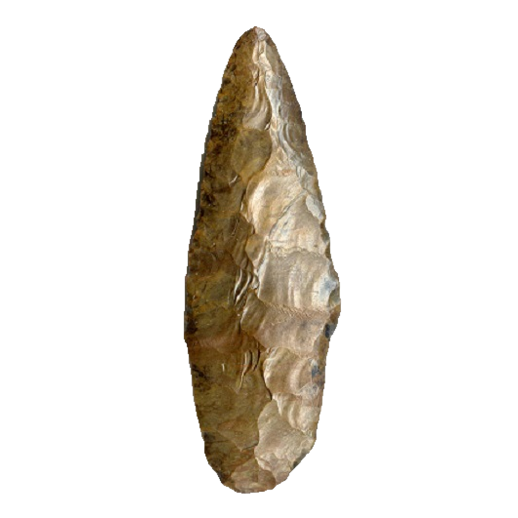
Arrowhead type
Sandia Point
Sandia14,000 - 10,000 B.P.Paleo19 reference photos
Key facts
- Age
- 14,000 - 10,000 B.P.
- Cultural period
- Paleo
- Size
- Medium
- Shape
- Straight Stem to Contracting Stem to Ovoid
- Glacial period
- Late Pleistocene
More from the Paleo period
Description
The stone tool repertoire comprises three distinct point types, each exhibiting unique characteristics.
Type I points are distinguished by their medium-sized stems and elliptical cross-sectional profiles. The blades of these points are excurvate, with one blade extending towards the base, while the opposing blade features a weak shoulder that slopes upward. The stems of Type I points can vary in shape, ranging from straight to contracting, and their bases can be either convex or pointed. The flaking pattern observed on these points is random.
In contrast, Type II points demonstrate a higher level of craftsmanship. These medium-stemmed points have diamond-shaped cross sections and excurvate blades, with one blade extending to the base and the other featuring a weak, upward-angled shoulder. The stems of Type II points can be straight or contracting, and their bases may be straight or concave. The flaking pattern on these points is also random, but the overall workmanship is more refined.
Type III points share many characteristics with Type II points, including medium stems, diamond-shaped cross sections, excurvate blades, and weak, upward-angled shoulders. However, a key distinguishing feature of Type III points is the presence of fluting, which sets them apart from their Type II counterparts. The stems and bases of Type III points exhibit similar variability to those of Type II points, with stems ranging from straight to contracting and bases ranging from straight to concave.
Size
The dimensions of the arrowheads are characterized by the following measurements: overall length ranges from 45 to 90 mm, while the stem length varies between 18 and 35 mm. Notably, the stem length typically constitutes 35 to 40% of the total length, although this proportion can fluctuate between 32% and 50%. The blade width spans 18 to 28 mm, and the stem width at the shoulder measures between 15 and 25 mm, based on a limited dataset.
Distribution
This type is mainly discovered from the southernmost Pecos area and throughout southeastern Texas and the middle coastal area of Texas. Honea (1965) notes that comparable specimens have been uncovered in central Texas, Oklahoma, Missouri, Iowa, and potentially Alabama, Alberta, and Saskatchewan
Additional information
The Sandia arrowhead type has been a subject of debate among archaeologists since its initial discovery. One of the primary concerns revolves around the radiocarbon dating of the site where these points were found. The dating process was compromised by the submission of incorrect samples, including an ivory specimen and a mastodon tooth, whose provenance was questioned by the laboratory. Furthermore, the dates obtained from samples allegedly sent by Kent Bryan are dubious, as Bryan never discussed these samples, and the laboratory has no record of receiving them.
A notable characteristic of the Sandia points is their association with a yellow ocher level at the site. All recovered Sandia points were found below this level and were covered in yellow ocher. However, when the yellow ocher was radiocarbon dated, it yielded an age of 300,000 years, which raises questions about the validity of the dates obtained from the Sandia level, ranging from 15,000 to 20,000 years. Additionally, the excavation uncovered 19 Sandia points, but surprisingly, few broken examples were found at the site. Closer examination of the points revealed that many lacked signs of wear, suggesting they had been protected, while others showed significant weathering, as if they had been exposed to blowing sand. The manufacturing techniques used to create these points also varied, with some exhibiting fine pressure flaking and others showing percussion flaking, and a range of materials were used. These differences in technique and material suggest that the points were crafted by multiple individuals.
The authenticity of some Sandia points has been further called into question by the presence of modern alterations, including the use of a grinding wheel to create shoulders on two of the examples. The limited geographic distribution of Sandia points, with only one other site, the Lucy Site in New Mexico, yielding these types, adds to the complexity of the issue. The Lucy Site, an open site subject to aeolian deflation, produced a mixed assemblage of points, including Clovis, Folsom, Sandia, and other archaic types, which has contributed to the ongoing debate surrounding the Sandia arrowhead type. The cumulative effect of these factors has led to a reevaluation of the significance and context of the Sandia points, highlighting the need for continued research and scrutiny to fully understand their place in the archaeological record.
Identified by
- Named by
- Frank C. Hibbins
- Year
- 1941
- Type site
- Sandia Cave, Sandoval County, New Mexico
Similar types
Types that are easy to confuse with the Sandia point.