
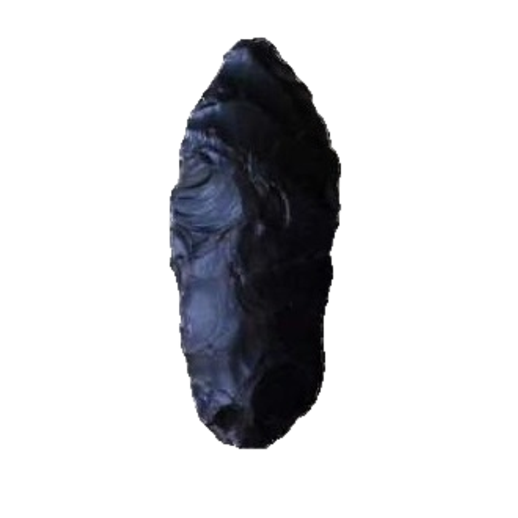
Arrowhead type
Lake Mohave Point
Lake MohaveGreat Basin Stemmed Cluster11,000 - 9,600 B.P.Transitional Paleo7 reference photos
Key facts
- Age
- 11,000 - 9,600 B.P.
- Cultural period
- Transitional Paleo
- Culture
- Western Stemmed Tradition
- Size
- Medium
- Shape
- Contracting Stem to Ovoid
- Glacial period
- Late Pleistocene to Early Holocene
More from the Paleo period
Description
This medium-sized lanceolate point exhibits a distinctive morphology, characterized by a contracting stem and a blade with an excurvate profile. The cross-sectional shape varies from diamond to elliptical, providing a stable platform for the point's functionality. Notably, the shoulders are often subdued or entirely absent, with a pronounced upward slope when present. In some instances, the blade and stem merge seamlessly on one edge, forming a continuous curve, while the opposing edge may feature a solitary shoulder. The stem itself is elongated, ranging from one-third to exceeding the length of the blade, and tapers inward in a contracting manner. The base of the point is marked by a convex curvature, and the hafting area displays evidence of intense grinding. Although thinning may be observed on the stem, the base remains unthinned. The flaking pattern on this point is random, with no discernible order or arrangement. Heavily resharpened examples may exhibit a shortened, stout blade accompanied by an elongated stem, underscoring the point's adaptability and utility.
Size
The dimensions of the arrowheads are characterized by the following measurements: overall length ranges from 28 to 92 mm, with a mean length typically falling between 35 to 50 mm. The stem component accounts for approximately half to three-quarters of the total length, measuring between 22 to 45 mm. The blade itself exhibits a width of 13 to 35 mm, while the thickness varies from 6 to 11 mm.
Distribution
This type is mainly discovered in the arid lake beds of middle California and extending into middle Nevada. These specimens have not been documented in the seaside areas of California. Lake Mohave has been identified as far as northern Baja California and at the La Playa site in northern Sonora, Mexico
Additional information
In the realm of Native American arrowhead typology, the Lake Mojave and Silver Lake types are two distinct categories that have been meticulously defined by Amsden. A key characteristic of the Lake Mojave type is its elongated, tapering stem, which is often accompanied by slight, narrow shoulders that may or may not be present. The overall shape of these arrowheads tends to be diamond-shaped, with the stem typically exceeding the length of the blade. Notably, the Lake Mojave type exhibits a range of forms, oscillating between oval and diamond shapes.
In contrast, the Silver Lake type is distinguished by a more pronounced definition of the shoulder, setting it apart from the Lake Mojave type. Another notable difference lies in the stem length, which is shorter in the Silver Lake type, never exceeding half the length of the blade and usually measuring around one-third of the length. Furthermore, the Silver Lake type is characterized by a convex base, a feature that contributes to its unique morphology.
The differentiation between these two types is crucial for understanding the technological and cultural nuances of the Native American groups that crafted them. By examining the subtle variations in shape, size, and form, archaeologists can gain valuable insights into the lives and traditions of these ancient cultures. The Lake Mojave and Silver Lake types, with their distinct characteristics, offer a fascinating window into the diversity and complexity of Native American arrowhead technology, highlighting the importance of meticulous typological analysis in the field of archaeology.
Identified by
- Named by
- Charles Amsden
- Year
- 1937
- Type site
- Lake Mojave Site
Similar types
Types that are easy to confuse with the Lake Mohave point.
Other types in the Great Basin Stemmed Cluster
- Crescent