
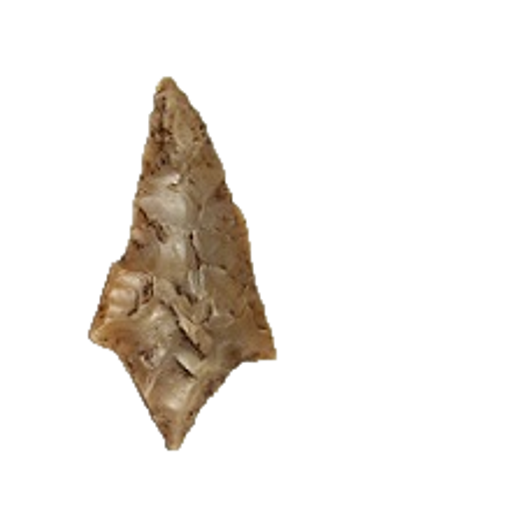
Arrowhead type
Cliffton Point
Cliffton700 - 400 B.P.Late Prehistoric8 reference photos
Key facts
- Age
- 700 - 400 B.P.
- Cultural period
- Late Prehistoric
- Size
- Small to Medium to Large
- Shape
- Contracting Stem
- Material
- Pottery
- Glacial period
- Medieval Warm to Little Ice Age
More from the Late Prehistoric period
Description
This triangular point features a distinctive stem that tapers inward, accompanied by a cross-sectional profile that has been deliberately flattened. The blade's curvature can range from straight to excurvate, often exhibiting asymmetry. Well-defined shoulders are a hallmark of this point, with their orientation varying from a horizontal alignment to a more pronounced, barbed configuration. The stem itself is notably short, with a base that can be either convex or taper to a point. Characteristically, this point is fashioned through unifacial chipping, resulting in a crudely made artifact that often originates from a single flake of stone. The flaking pattern observed on this point is random, lacking a deliberate or organized arrangement.
Size
The dimensions of the arrowheads are characterized by a total length ranging from 20 to 40 mm, with the stem length measuring between 1 to 5 mm, and a width spanning 15 to 20 mm, as outlined by Suhm and Krieger (1954).
Distribution
This type is mainly predominantly located in the Red River Valley of Texas, Oklahoma, Arkansas and Louisiana. The occurrence dwindles the further south, but extends into central Texas, the coastal area and into central Tamaulipas.
Additional information
The classification of this particular arrowhead type has been a subject of debate among archaeologists. Some researchers, including Turner and Hester (1985), have suggested that it lacks distinctiveness and is, in fact, an unfinished example of the Perdiz point. This notion is supported by the fact that Miller and Jelks (1952) referred to a similar type as the Foyle Flake, which is now widely regarded as synonymous with the former. Many experts consider both types to be precursors or preforms of the Perdiz type, highlighting the complexities of arrowhead typology.
Notably, Walter W. Taylor (1966) conducted extensive research in northeastern Mexico, where he encountered this type and designated it as the Ojo contracting stem. This designation underscores the geographic and cultural context in which these arrowheads were crafted and used. The Ojo contracting stem, or Foyle Flake, represents an important stage in the development of the Perdiz point, which is a significant artifact in the archaeological record of Native American cultures.
The study of this arrowhead type offers valuable insights into the technological and cultural practices of Native American communities. By examining the characteristics and evolution of these artifacts, researchers can gain a deeper understanding of the social, economic, and environmental factors that shaped the lives of these communities. As archaeologists continue to refine their understanding of arrowhead typology, the Ojo contracting stem and its relationship to the Perdiz point remain essential components of this ongoing inquiry, providing a unique window into the history and traditions of Native American cultures.
Identified by
- Named by
- Alex D. Krieger
- Year
- 1946
- Type site
- Multiple sites around the town of Clifton.
Similar types
Types that are easy to confuse with the Cliffton point.