
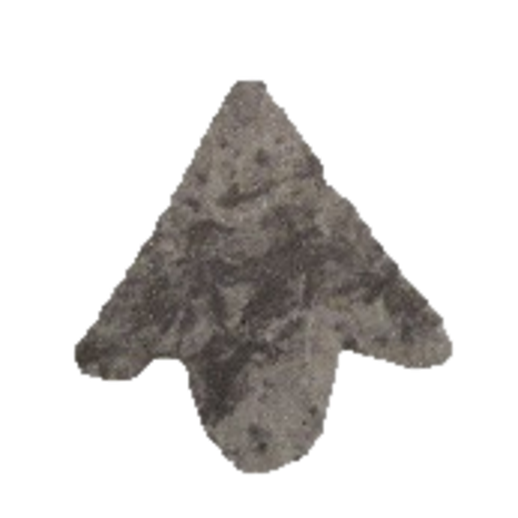
Arrowhead type
Coxtanlan Point
Coxtanlan4,000 - 2,500 B.P.Late Archaic to Transitional Archaic4 reference photos
Key facts
- Age
- 4,000 - 2,500 B.P.
- Cultural period
- Late Archaic to Transitional Archaic
- Size
- Small to Medium
- Shape
- Contracting Stem to Corner Notch
- Glacial period
- Neoglacial
More from the Archaic period
Description
This triangular point exhibits a slender profile, characterized by a narrow cross-sectional thickness. Its blade morphology varies from straight to subtly curved, often featuring delicate serrations and beveled edges. Notably, the point's width typically exceeds its length, lending it a distinctive proportions. The shoulders are marked by barbs that protrude at a perpendicular angle to the point's longitudinal axis. The stem tapers inward, terminating in a base that is usually pointed, although occasionally convex in shape. Fabrication of this point type involves the initial removal of a thin flake, followed by meticulous thinning and shaping achieved through precise pressure flaking techniques. The resultant artifact displays exceptional craftsmanship, as evidenced by its refined features and irregular, random flaking pattern.
Size
The dimensions of the arrowheads are as follows: they range in length from 25 to 56 mm, with a mean length of 33 mm. The stem length varies between 6 and 14 mm, averaging 10 mm. In terms of width, the blade spans 20 to 47 mm, with an average width of 34 mm, while the stem width ranges from 5 to 20 mm, averaging 13 mm. The thickness of the arrowheads measures between 7 and 15 mm, with an average thickness of 6 mm, however, it seems there might be a discrepancy in the average thickness value provided, as the range suggests a minimum of 7 mm, but for the purpose of this description, we will maintain the provided average of 6 mm as per the original data.
Distribution
This variety is documented in the Mexico Valley, Tehuacan region, Oaxacan state, Hidalgo territory, and Sierra Gordo, Queretaro, Mexico
Mainly found in
Additional information
In comparing the morphological characteristics of these points, it is notable that they bear a resemblance to Garyito points, albeit with distinct differences in size and width. Specifically, these points tend to be smaller in overall dimensions and narrower in width compared to the more commonly observed Coxtanlan points. This observation is consistent with the findings of MacNeish (1967), who documented the variability in point morphology among different cultural contexts. The smaller size and narrower width of these points suggest a potential difference in functional use or cultural affiliation, highlighting the importance of careful analysis and consideration of multiple factors in the classification and interpretation of archaeological artifacts.
Identified by
- Named by
- Richard S. MacNeish
- Year
- 1967
Similar types
Types that are easy to confuse with the Coxtanlan point.