
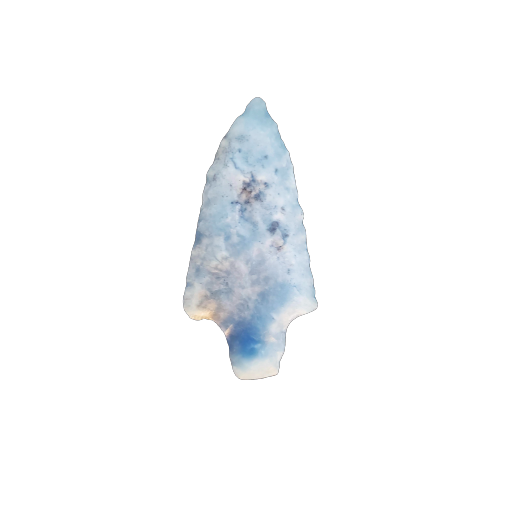
Arrowhead type
Augustin Point
AugustinGypsum Cave Cluster7,000 - 5,000 B.P.Developmental to Classic to Late Prehistoric5 reference photos
Key facts
- Age
- 7,000 - 5,000 B.P.
- Cultural period
- Developmental to Classic to Late Prehistoric
- Size
- Small to Medium
- Shape
- Contracting Stem
- Glacial period
- Middle Holocene
More from the Late Prehistoric, Developmental, Preclassic and Classic periods
Description
This triangular point exhibits a distinctive morphology, characterized by a contracting stem and an elliptical cross-sectional profile. The blade's curvature can range from subtly excurvate to straight, often accompanied by fine serrations. Prolonged re-sharpening can result in a shortened, incurvate blade shape. The shoulders typically present as horizontal, although repeated re-sharpening can lead to a reduction in shoulder prominence or an upward inclination. The stem tapers inward, terminating in a convex base. The flaking pattern on this point is random, lacking a discernible, organized arrangement.
Size
The dimensions of these arrowheads are characterized by a total length ranging from 27 to 60 mm, with a mean length of 44 mm. The stem portion measures between 7 and 19 mm in length. In terms of blade dimensions, the width spans from 16 to 27 mm, averaging 21 mm. The thickness of the arrowheads falls within a range of 5 to 10 mm.
Distribution
This style is mainly located in Sinaloa, Durango, Sonora, and Chihuahua Mexico, stretching into southwestern Coahuila, southwestern Arizona, southeastern New Mexico, and northwestern Texas
Mainly found in
Additional information
More information needed.
Identified by
- Named by
- Herbert Dick
- Year
- 1965
- Type site
- Bat Cave, New Mexico
Similar types
Types that are easy to confuse with the Augustin point.