
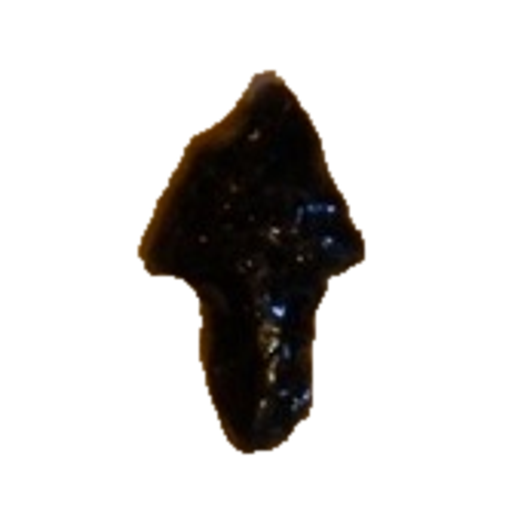
Arrowhead type
Garyito Point
Garyito3,500 - 2,800 B.P.Early Formative3 reference photos
Key facts
- Age
- 3,500 - 2,800 B.P.
- Cultural period
- Early Formative
- Culture
- Ajalpan Phase
- Size
- Small
- Shape
- Contracting Stem
- Glacial period
- Neoglacial
Description
This triangular point exhibits a slender, oval-shaped profile, with a blade that displays a subtle curvature, ranging from straight to gently concave. The shoulders are characterized by a notable variability, spanning from faint and angled upwards to pronounced and hooked. The stem tapers inward, terminating in a base that can be either sharply pointed or rounded with a convex shape.
Size
The arrowheads exhibit the following dimensional characteristics: their overall length ranges from 22 to 46 mm, with a mean length of 29 mm. The stem, a crucial component, measures between 5 and 17 mm in length, averaging 10 mm. In terms of width, the blade spans 17 to 30 mm, with an average width of 24 mm. Conversely, the stem width varies from 8 to 19 mm, averaging 10 mm. Lastly, the thickness of these arrowheads falls within a range of 4 to 10 mm, with an average thickness of 6 mm.
Distribution
This artifact has been discovered in regions including Oaxaca, Puebla, Hidalgo, Queretaro, the Mexico Valley, and the Tehuacan Valley
Mainly found in
Additional information
In comparison to the Coxtanlan point, a distinct type of arrowhead exhibits notable differences in terms of size and width. Specifically, these points are generally smaller in scale and narrower in width than their Coxtanlan counterparts. This observation is supported by the research of MacNeish, published in 1967, which highlights the unique characteristics of these arrowheads. The smaller size and reduced width of these points suggest a potential variation in functional purpose or cultural affiliation, underscoring the complexity and diversity of Native American arrowhead typology.
The distinction between these points and the Coxtanlan point is significant, as it implies a level of craftsmanship and design intention that is specific to a particular cultural or regional context. The fact that these points are consistently smaller and narrower than Coxtanlan points suggests a deliberate choice on the part of the manufacturers, potentially driven by factors such as available materials, hunting practices, or symbolic expression. Further study of these points and their associated cultural contexts may provide valuable insights into the lives and traditions of the Native American communities that created them.
The research of MacNeish (1967) provides a foundational understanding of the Coxtanlan point and its variants, including the smaller and narrower points in question. By examining the morphological characteristics of these arrowheads, archaeologists can gain a deeper appreciation for the technological, social, and cultural factors that shaped the development of Native American projectile point technology. As such, continued analysis and comparison of these points with other types of arrowheads can contribute to a more nuanced understanding of the historical and cultural contexts in which they were created and used.
Identified by
- Named by
- Richard S. MacNeish
- Year
- 1967
Similar types
Types that are easy to confuse with the Garyito point.