
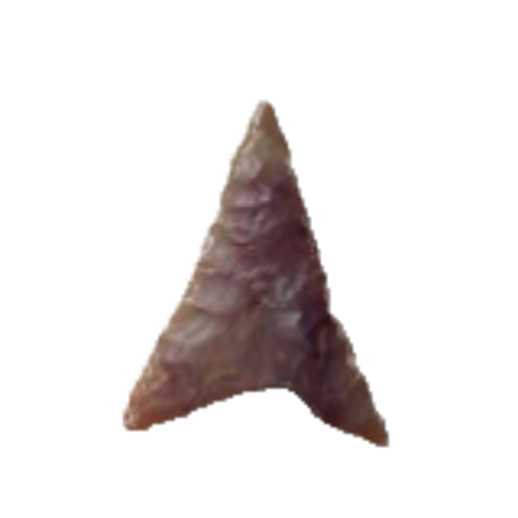
Arrowhead type
McGloin Point
McGloinLate Southern Triangle Cluster1,300 - 500 B.P.Late PrehistoricKey facts
- Age
- 1,300 - 500 B.P.
- Cultural period
- Late Prehistoric
- Size
- Small
- Shape
- Triangle
- Glacial period
- Little Ice Age
More from the Late Prehistoric period
Description
This projectile point exhibits a compact, angular form, typically ranging from triangular to pentagonal in outline. Its cross-sectional profile is characterized by an elliptical to flattened shape, providing a stable and balanced configuration. The blade's curvature can vary, spanning from excurvate to straight, with some specimens displaying a subtle angulation at the distal end, which contributes to the point's pentagonal appearance. The proximal end is marked by a concave base, often featuring a pronounced, V-shaped indentation. The flaking pattern observed on this point is random, lacking a discernible, organized arrangement.
Size
The dimensions of the arrowheads range from 20 to 35 millimeters in overall length and 10 to 20 millimeters in width.
Distribution
This type is located in the Corpus Christi Bay area.
Mainly found in
Additional information
In the realm of Native American arrowhead studies, the McGloin point presents a fascinating case of overlapping characteristics, often found in association with Starr points, as noted by Turner and Hester in their 1985 research. A key distinguishing feature of the McGloin point, however, is the absence of the exceptionally fine flaking patterns that are typically observed on Maud and Turney points, a characteristic highlighted by Moore in 2015. This distinction is crucial in understanding the unique attributes of the McGloin point, which sets it apart from other point types within the same cultural and temporal context.
The McGloin point's association with Starr points suggests a shared cultural or functional significance, potentially indicating a period of coexistence or overlap between the two point styles. Further examination of the McGloin point's characteristics, including its flaking patterns, reveals a more nuanced understanding of the technological and stylistic developments within the culture that produced these points. The lack of fine flaking on McGloin points, in contrast to Maud and Turney points, may imply differences in the manufacturing process, raw material selection, or the intended use of these points.
The study of McGloin points, in conjunction with other point types like Starr, Maud, and Turney, contributes to a richer understanding of the complex cultural dynamics and technological advancements of Native American societies. By analyzing the characteristics and associations of these points, researchers can reconstruct a more detailed picture of the lives and traditions of the people who created them, shedding light on the historical and cultural contexts in which they were used. As archaeological research continues to uncover new insights into the world of Native American arrowheads, the McGloin point remains an important component of this ongoing narrative, offering a unique window into the technological, cultural, and historical developments of the region.
Identified by
- Named by
- James E. Corbin, Ellen Sure Turner, and Thomas Hester
- Year
- 1963
- Type site
- McGloin Bluff Site, Corpus Christi Bay, Texas
Similar types
Types that are easy to confuse with the McGloin point.