
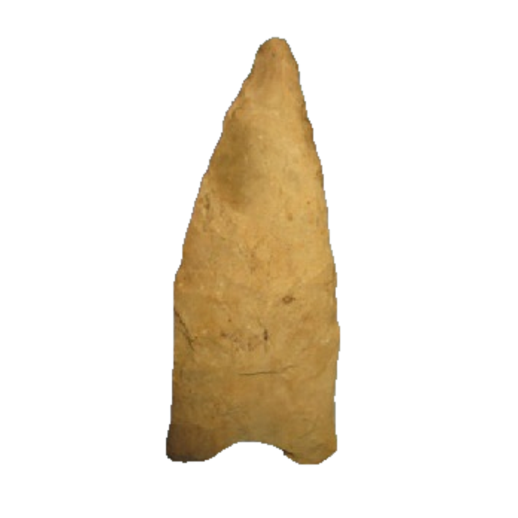
Arrowhead type
Golodrina Point
GolodrinaPlano Lanceolate Cluster9,000 - 7,000 B.P.Transitional Paleo13 reference photos
Key facts
- Age
- 9,000 - 7,000 B.P.
- Cultural period
- Transitional Paleo
- Size
- Medium to Large
- Shape
- Auriculate to Lanceolate
- Material
- Jasper
- Glacial period
- Early to Middle Holocene
More from the Paleo period
Description
This triangular point measures between 1.25 and 1.75 inches in length, characterized by a stemmed to expanding stem morphology and a flattened cross-sectional profile. The blade edge is predominantly straight, terminating in a sharp, well-defined tip. The stem is elongated and subtly expands in width, while the base exhibits a range of forms, from straight to mildly convex. The flaking pattern observed on this point is random, lacking a discernible, organized arrangement.
Size
The arrowheads exhibit the following dimensional characteristics: their length ranges from 32 to 78 mm, while the blade width spans 23 to 32 mm. Notably, the waist width is generally 1 to 3 mm less than the blade width. The basal width is measured between 20 to 33 mm, and also reported as 22 to 29 mm, indicating a possible range of variation. The thickness of the arrowheads is consistently between 6 to 8 mm. Additionally, the basal concavity is recorded as 4 mm or more.
Distribution
This type is predominantly discovered in the southern regions of Texas Plains, extending into southern Tamaulipas, northern Zacatecas, and eastern Chihuahua. Specimens are widespread throughout Texas, reaching into southeastern New Mexico and Arkansas. Occasional sightings have been documented in Missouri, Kansas, and Louisiana, although these are relatively rare
Additional information
In the realm of Native American archaeology, a specific type of arrowhead has garnered significant attention due to its distinct characteristics. Initially, this point was referred to as the Plainview Golondrina point by LeRoy Johnson, highlighting its perceived affinity with the Plainview point. However, subsequent research conducted by T.C. Kelley in 1982 led to a reevaluation of this classification, ultimately resulting in the recognition of the Golondrina point as a unique and separate entity. This distinction was aptly reflected in the shortening of its original name to simply Golondrina.
A notable aspect of the Golondrina point is its morphology, which sets it apart from its Plainview counterpart. As observed by Turner and Hester in 1985, the Golondrina point tends to exhibit a wider and thicker profile compared to the Plainview type. This differentiation underscores the importance of meticulous analysis and classification in archaeological studies, as subtle variations in artifact morphology can have significant implications for our understanding of cultural and technological developments among Native American groups.
The recognition of the Golondrina point as a distinct type underscores the complexity and diversity of Native American lithic traditions. By acknowledging and characterizing these variations, researchers can gain valuable insights into the technological, social, and cultural contexts in which these artifacts were created and utilized. The Golondrina point, with its unique dimensions and characteristics, serves as a testament to the ingenuity and craftsmanship of Native American communities, highlighting the need for continued research and exploration into the rich and fascinating history of these cultures.
Identified by
- Named by
- LeRoy Johnson Jr.
- Year
- 1964
- Type site
- The Devils Mouth Site, Amistad Reservoir, Val Verde County, Texas
Similar types
Types that are easy to confuse with the Golodrina point.