
Arrowhead type
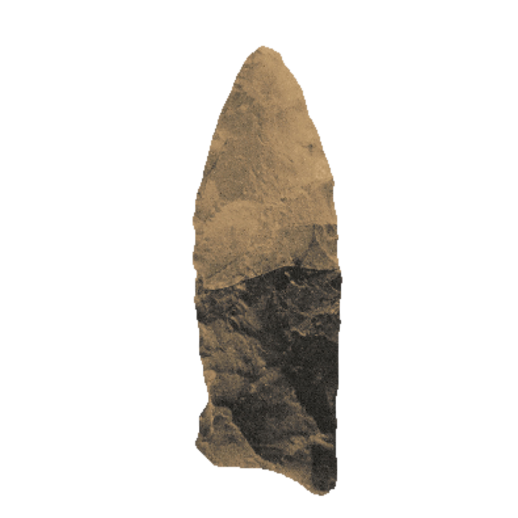
El Riego Point
El Riego8,500 - 6,800 B.P.Transitional Paleo to Early2 reference photos
Key facts
- Age
- 8,500 - 6,800 B.P.
- Cultural period
- Transitional Paleo to Early
- Size
- Medium to Large
- Shape
- Lanceolate
- Glacial period
- Early to Middle Holocene
More from the Paleo period
Description
This lanceolate specimen exhibits a distinctive elongated shape, characterized by an elliptical cross-section and a curved profile. The blade's excurvate shape is marked by an inward-curving tip that gradually becomes parallel to the base, with a possible subtle contraction in width towards the base. Serrations may be present along the blade's edge. The base of the tool is notable for its deep concavity. The area intended for hafting often displays extensive grinding, including basal grinding. The manufacturing process involves an initial stage of perfusion flaking to shape the preform, followed by controlled pressure flaking to refine the tool's form. The basal edge is thinned through percussion flaking and subsequently polished by grinding. The overall flaking pattern appears largely random, although instances of collateral flaking can be observed.
Size
The dimensions of the arrowheads are as follows: they range in length from 50 to 108 mm, with a mean length of 81 mm. The width varies between 24 and 35 mm, averaging 30 mm. In terms of thickness, the measurements span from 7 to 14 mm, with an average of 9 mm. Additionally, the basal concavity is measured between 10 and 27 mm, with a mean of 15 mm, as reported by MacNeish in 1967.
Distribution
This style is mainly located in the Tehuacan Valley of Mexico. Nonetheless, specimens discovered in the Valley of Mexico classified as "Meserve Like" are more typical of this style
Additional information
More information needed.
Identified by
- Named by
- Richard MacNeish
- Year
- 1961
- Type site
- El Riego Cave, Tehuacan Valley, Mexico
Similar types
Types that are easy to confuse with the El Riego point.