
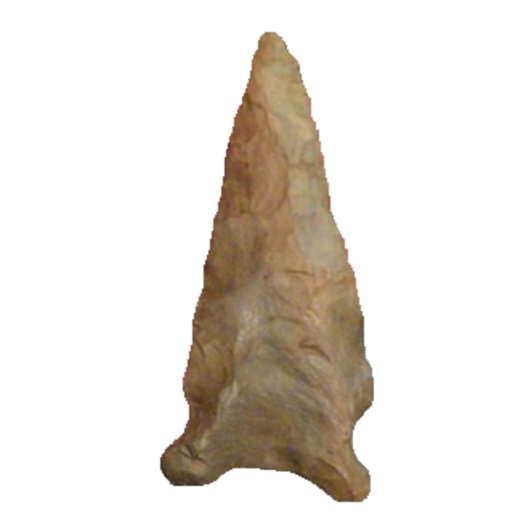
Arrowhead type
Breckenridge Point
BreckenridgeDalton Cluster10,500 - 8,500 B.P.Transition Paleo11 reference photos
Key facts
- Age
- 10,500 - 8,500 B.P.
- Cultural period
- Transition Paleo
- Size
- Medium to Large
- Shape
- Auriculate
- Glacial period
- Early Holocene
More from the Paleo period
Description
This auriculate point exhibits a slender profile, measuring between 2 3/8 and 3 ¼ inches in length, with a cross-sectional shape that ranges from elliptical to flattened or rhomboid. The blade's curvature can vary, displaying a subtle excurvate or incurvate shape, particularly in re-sharpened specimens. A distinctive feature of this point is the steep beveling of its edges, often alternating and typically oriented in a right-handed direction, although left-handed beveling can occur. Serrations may also be present along the blade. The notches, characterized by a shallow and broad u-shaped form, are positioned low on the blade and create a shoulder that is weak and angled upward, transitioning into a stem that expands outward. Notably, the stem is relatively short, with the point's maximum width occurring at its base, which is concave in shape. Although basal thinning can occasionally give the appearance of fluting, this point does not exhibit true fluting. The hafting region displays moderate grinding, accompanied by light grinding at the base. The stem often features beveling that is opposite in orientation to the blade, adding to the point's complexity. The flaking pattern on this point can exhibit a range of styles, including oblique transverse, horizontal transverse, collateral, or random arrangements.
Size
The dimensions of these arrowheads are characterized by a total length ranging from 60 to 83 mm, with an average measurement of 74 mm. The stem portion measures between 13 to 17 mm in length. In terms of width, the blade and basal areas span 24 to 28 mm, averaging 26 mm. Notably, the blade width may increase in specimens that have undergone minor re-sharpening, whereas the base width tends to expand in more extensively re-sharpened examples. The thickness of these arrowheads falls within a range of 8 to 10 mm.
Distribution
This type is mainly discovered in the Ozark area of southern Missouri, northern Arkansas, northeastern Oklahoma, and extending into southeastern Kansas. This type may also appear in the Illinois and Mississippi Alluvial Lowland area.
Additional information
The evolution of this particular arrowhead point is believed to have culminated in the development of the Graham Cave point, as noted by researchers Ray and Lopinot in their 2005 publication. A significant contribution to the understanding of this point can be attributed to Ronald Thomas, who conducted an in-depth examination of the Breckenridge site as part of his Master's thesis at the University of Missouri, completed in 1969. Notably, Thomas initially documented this point in 1962, providing early insight into its characteristics and significance. This foundational work has since informed our comprehension of the point's place within the broader context of Native American archaeological findings.
The Breckenridge site, subject of Thomas's thesis, offers a unique window into the lives and cultural practices of the Native American communities that once inhabited the region. The point in question, with its distinct morphology, has been the focus of scholarly attention due to its potential to shed light on the technological and stylistic developments of these communities. By examining the characteristics of this point, researchers can gain a deeper understanding of the cultural exchange networks, technological innovations, and adaptive strategies employed by Native American groups during this period.
The work of Ronald Thomas, particularly his early documentation of the point in 1962 and his subsequent Master's thesis, has played a pivotal role in shaping our current understanding of this archaeological find. The connection to the Graham Cave point, as identified by Ray and Lopinot, underscores the importance of considering the evolutionary trajectory of arrowhead points within the context of Native American cultural and technological development. As archaeological research continues to uncover new insights into the lives and traditions of Native American communities, the study of artifacts like this point remains essential for reconstructing the complex and dynamic history of these societies.
Identified by
- Named by
- W. Raymond Wood and Ronald A. Thomas in 1962
- Year
- 1962
- Type site
- Breckenridge Rock Shelter (3CR2), northwestern Arkansas
Similar types
Types that are easy to confuse with the Breckenridge point.
Other types in the Dalton Cluster
- Beaver Lake
- Dalton
- Dalton Colbert
- Dalton Greenbrier
- Dalton Hemphill
- Dalton Hempstead
- Dalton Nuckolls
- Dalton Sloan
- Hardaway Dalton
- Hi-Lo
- Quad