
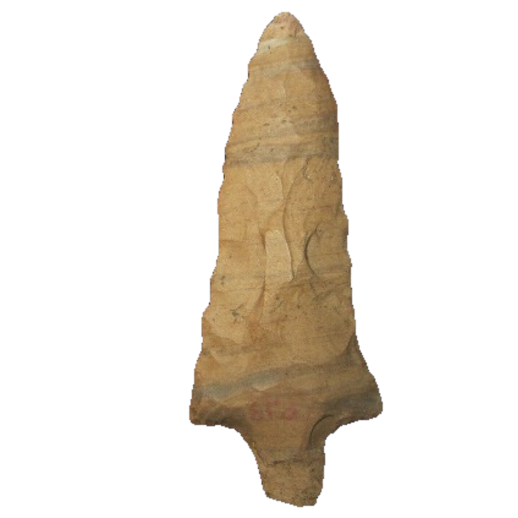
Arrowhead type
Wright Point
Wright2,500 - 2,000 B.P.Woodland7 reference photos
Key facts
- Age
- 2,500 - 2,000 B.P.
- Cultural period
- Woodland
- Size
- Medium
- Shape
- Straight Stem to Contracting Stem
- Material
- Jasper
- Glacial period
- Roman
More from the Woodland period
Description
This medium-stemmed projectile point exhibits a varied cross-sectional profile, which can be elliptical, flattened, or assume a rhomboid shape. The blade's curvature is versatile, ranging from straight to excurvate or outwardly recurvate, often accompanied by fine serrations that impart a distinctive texture. Notably, the blade's morphology is frequently asymmetrical, adding to the point's unique character. The shoulders, also often asymmetrical, can be oriented at an upward angle or display a subtle barbing. The stem, straight in orientation, terminates in a base that is either straight or slightly convex. The flaking pattern observed on this point is random, lacking a discernible order or sequence.
Size
The arrowhead's dimensions are as follows: it measures between 47 and 83 millimeters in overall length, with a stem length ranging from 10 to 17 millimeters. The blade width spans 28 to 45 millimeters, while the stem width is between 10 and 17 millimeters. In terms of thickness, the arrowhead is between 6 and 7 millimeters.
Distribution
This type is mainly discovered throughout the Tennessee River Valley region and neighboring territories.
Mainly found in
Additional information
More information needed.
Identified by
- Named by
- Skip Hutchison, Ralph Allen, and Dennis Bushey
- Year
- 1991
Similar types
Types that are easy to confuse with the Wright point.
Other types in this cluster
- Cotaco Wright
- Cotaco Creek Blade
- Ledbetter
- Mulberry Creek