
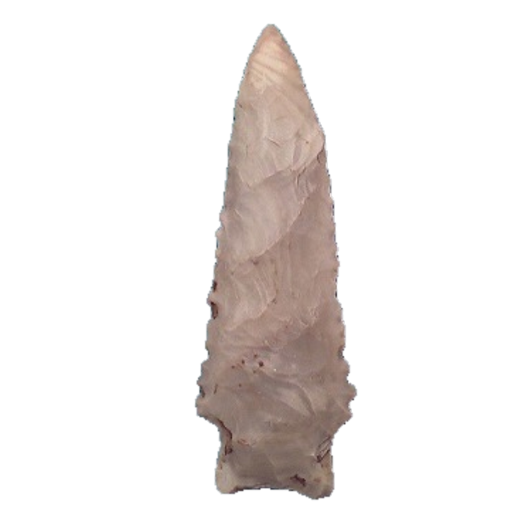
Arrowhead type
Kirk Serrated Point
Kirk SerratedKirk Stemmed Cluster9,500 - 8,500 B.P.Early Archaic27 reference photos
Key facts
- Age
- 9,500 - 8,500 B.P.
- Cultural period
- Early Archaic
- Size
- Medium to Large
- Shape
- Straight Stem to Expanding Stem to Bifurcated
- Material
- Flint
- Glacial period
- Early Holocene
More from the Archaic period
Description
This triangular stemmed point exhibits a medium to large size range and features an elliptical cross-sectional profile. The blade morphology is typically characterized by a straight or subtly excurvate shape, with the latter being less prevalent. Notable are the coarse, tooth-like serrations that adorn the blade, originating at the shoulders and often extending between two-thirds to three-quarters of the way up the blade's length. Many specimens display alternating beveled edges along the blade, adding to their distinctive appearance. The shoulders of this point type are generally marked by slight barbing, although some variability is observed, ranging to nearly horizontal configurations. The stem itself is often straight, but may exhibit a slight expansion, while the base can vary from concave to bifurcate in shape. Although the stem is commonly thinned, it typically lacks evidence of smoothing. The flaking pattern observed on this point is random, lacking a discernible pattern or organization.
Size
The dimensions of the arrowheads are as follows: they typically range in overall length from 45 to 120 mm, with a mean length of 65 mm. The stem section measures between 8 and 13 mm in length, averaging 11 mm. The blade itself spans a width of 24 to 45 mm, with an average width of 30 mm. The stem width falls within a range of 15 to 20 mm, averaging 17 mm. In terms of thickness, the arrowheads vary from 5 to 14 mm.
Distribution
This type is mainly linked to the Atlantic Coast area of the United States, extending into the Gulf Coast area and the Tennessee River and Ohio River valleys. This type is also discovered in the Mississippi River Valley and the Northeastern United States, albeit with less regularity
Additional information
In the realm of Native American archaeology, the classification of certain arrowhead types has sparked debate among experts. Specifically, the Kirk Serrated and Kirk Stemmed points have been subject to discussion regarding their distinctiveness. While some researchers contend that these two types are, in fact, the same, others, such as Justice (1987), argue that they should be recognized as separate entities based on the morphology of their bases. Notably, the Kirk Serrated point often exhibits a concave or bifurcated base, whereas the Kirk Stemmed point typically features a straight base. However, it is essential to acknowledge that exceptions exist, with some serrated points displaying straight bases and some stemmed points showing bifurcated bases without serrations.
The work of Johnson et al. (2009) highlights the complexity of this issue, suggesting that the base of the point is the primary criterion for differentiation. Interestingly, their research reveals that not all Kirk Serrated points are serrated, and conversely, some Kirk Stemmed points do exhibit serrations. This overlap underscores the need for careful consideration when categorizing these points. From a chronological perspective, the Kirk Stemmed point has been dated to a later period than the Kirk Corner Notch point, according to Farr (2006). This temporal relationship is significant, as it provides insight into the evolutionary trajectory of these arrowhead types.
The Kirk Stemmed point is thought to have played a role in the development of subsequent point styles, notably the Stanly point. This evolutionary connection underscores the importance of understanding the nuances of these early arrowhead types, as they provide a window into the technological and cultural advancements of Native American societies. By examining the characteristics and temporal relationships of these points, researchers can gain a deeper appreciation for the complexities of Native American archaeology and the dynamic nature of technological innovation in these ancient cultures.
Identified by
- Named by
- Joffre L. Coe
- Year
- 1964
- Type site
- Hardaway Site, Stanly County, North Carolina
Similar types
Types that are easy to confuse with the Kirk Serrated point.
- Elora
- Flint Creek
- Hamilton
- Heavy Duty
- Jackie
- Searcy
- Stanly
Other types in the Kirk Stemmed Cluster
- Jakie Stemmed
- Kirk Corner Notch
- St. Tammany