
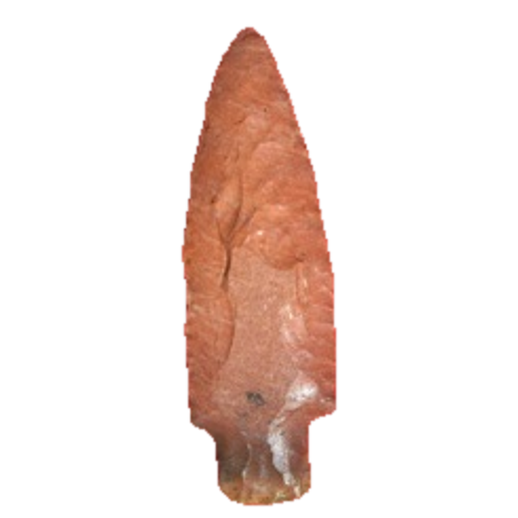
Arrowhead type
Little Bear Point
Little BearDickson Contracting Stem Cluster3,500 - 1,500 B.P.Late Archaic to Early Woodland26 reference photos
Key facts
- Age
- 3,500 - 1,500 B.P.
- Cultural period
- Late Archaic to Early Woodland
- Size
- Medium to Large
- Shape
- Straight Stem
- Glacial period
- Neoglacial to Roman Warm
Description
This triangular stemmed point exhibits a size range of 2.25 to 3.5 inches, characterized by an elliptical cross-sectional profile. The blade's morphology is typically narrow, often displaying an excurvate curvature, although straight examples are also present. Asymmetry is a common feature of the blade. The shoulders of the point can exhibit a range of orientations, from horizontal to angled upward. The stem is elongated, with a shape that can be either parallel-sided or slightly tapering. The base of the point is generally straight-edged and may retain an unfinished quality. Basal grinding is a typical feature, indicating deliberate edge modification. The flaking pattern observed on this point is random, lacking a consistent or organized arrangement of flake scars.
Size
The dimensions of the arrowheads are as follows: they range in overall length from 54 to 90 mm, with a typical length of 65 to 75 mm. The stem length varies between 9 and 20 mm, averaging 12 to 18 mm. The width of the blade spans 22 to 37 mm, with an average width of 24 to 31 mm. At the shoulders, the stem width measures between 14 and 23 mm, typically ranging from 16 to 18 mm. The basal width ranges from 9 to 19 mm, with an average of 14 to 15 mm. In terms of thickness, the arrowheads measure between 7 and 11 mm.
Distribution
These artifacts are mainly discovered in the Tennessee River Basin and the corresponding upper streams in North Carolina and South Carolina
Also found, less often, in
Additional information
The arrowhead cluster in question spans a significant period, from the late Archaic era to the early and middle Woodland periods, roughly corresponding to the timeframe outlined by Justice in 1987. Notably, the majority of points within this cluster are associated with the Adena culture, which was predominantly centered in the Ohio River valley. However, the specific point under examination does not belong to the Adena culture, despite sharing morphological similarities and a comparable temporal and geographical context with other points in the cluster.
A key observation is that Adena points are thought to have originated from the Cresap point, but this particular point does not share the same ancestral roots. Instead, it bears a resemblance to the Kramer point, albeit with distinct differences. The Kramer point, characterized by its wider stem, is primarily found in the Ohio River valley, whereas this point typically features a narrower stem and is more commonly associated with the Tennessee River valley, as highlighted by Cambron and W14. This distinction underscores the importance of careful analysis in identifying and categorizing arrowhead types, as subtle variations can reveal significant cultural and geographical differences.
The presence of this point in the cluster, despite its non-Adena origins, underscores the complexity and diversity of arrowhead production during this period. The overlap in morphological characteristics and temporal context highlights the need for a nuanced understanding of the cultural and technological exchanges that occurred among prehistoric societies. By examining the unique characteristics of this point, such as its narrower stem and Tennessee River valley provenance, researchers can gain a deeper insight into the regional variations and cultural influences that shaped the development of arrowhead technology during the late Archaic to early Woodland periods.
Identified by
- Named by
- William Webb and David DeJarnette
- Year
- 1948
- Type site
- Little Bear Creek Site, Alabama
Similar types
Types that are easy to confuse with the Little Bear point.
- Bare Island
- Cotaco Wright
- Cresap
- Elk River
- Hamilton Stemmed
- Kays
- Mulberry Creek
- New Market
- Pickwick
- Pontchartrain
Other types in the Dickson Contracting Stem Cluster
- Adena
- Adena Dickson
- Gary
- Poplar Island
- Rossville