
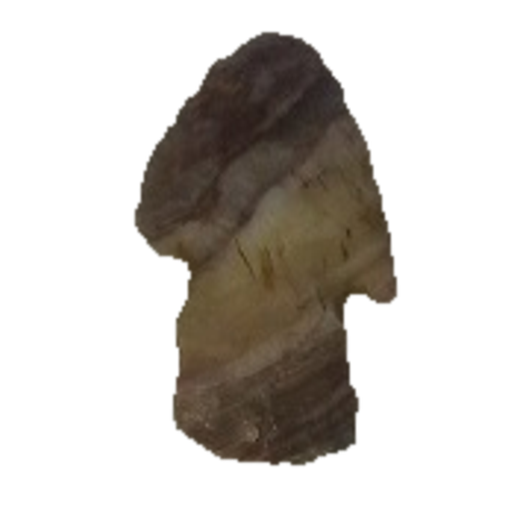
Arrowhead type
Ventana Amargosa Point
Ventana Amargosa7,000 - 5,000 B.P.Middle Archaic3 reference photos
Key facts
- Age
- 7,000 - 5,000 B.P.
- Cultural period
- Middle Archaic
- Size
- Small to Medium
- Shape
- Straight Stem to Contracting Stem
- Glacial period
- Middle Holocene
More from the Archaic period
Description
This triangular stemmed point exhibits a compact to moderate size, characterized by an elliptical profile. The blade edge can display a range of curvature, from straight to subtly convex. The shoulder morphology is typically marked by a horizontal or slightly hooked orientation, although re-sharpening can lead to a reduction in shoulder prominence, resulting in an upward inclination or a more subdued appearance. The stem's dimensions can vary, ranging from a slight expansion to a gentle contraction, with many specimens featuring a lengthy stem that comprises approximately one-third to one-half of the point's overall length. The basal margins are distinguished by rounded corners, accompanied by a base that is either straight or exhibits a slight convexity. The flaking pattern on this point is characterized by a non-directional, random arrangement of flakes.
Size
The arrowhead's dimensions are as follows: overall length ranges from 29 to 41 mm, with the stem portion measuring between 10 to 16 mm. The blade itself spans a width of 19 to 27 mm, while the stem width falls within the range of 12 to 17 mm.
Distribution
This type is predominantly linked to Arizona, yet can also occur across the Southwest and extend into southern Colorado Plateau, as well as Chihuahua and Sonora in Mexico
Mainly found in
Additional information
In the realm of Native American archaeology, a specific type of arrowhead has undergone a notable evolution in its classification. Initially, these points were identified as Amargosa Type 1 points, a designation that reflected their unique characteristics. However, subsequent research and discoveries led to a reevaluation of their categorization. The red sand level of Ventana Cave, a significant archaeological site, played a crucial role in this reclassification. As a result, these points came to be known as Amargosa-Ventana points, a name that acknowledges their association with both the Amargosa and Ventana Cave contexts, as first proposed by Haury in his designation of the Amargosa-Ventana 1 level.
Despite this updated nomenclature, some scholarly publications continue to refer to these points as Amargosa Type 1 points, as evident in the works of Stone (1986) and Brown (1982). This dual usage highlights the complexities and nuances inherent in the field of archaeology, where classifications and terminology can evolve over time as new evidence and insights emerge. The persistence of the original designation in some sources serves as a reminder of the ongoing dialogue and refinement that characterize the discipline.
The Amargosa-Ventana points remain an important area of study, offering valuable insights into the cultural and technological practices of Native American communities. By examining these artifacts and their classification history, researchers can gain a deeper understanding of the complexities and variations that exist within the archaeological record. As our knowledge and understanding of these points continue to grow, their significance as a window into the past will only continue to increase, providing a rich source of information for scholars and enthusiasts alike.
Identified by
- Named by
- Emil W. Haury
- Year
- 1950
- Type site
- Ventana Cave, southwestern Arizona
Similar types
Types that are easy to confuse with the Ventana Amargosa point.