
Arrowhead type
Axolotl Point
Axolotl1,700 - 800 B.P.Developmental4 reference photos
Key facts
- Age
- 1,700 - 800 B.P.
- Cultural period
- Developmental
- Culture
- Primer, Segundo, Tercer Period
- Size
- Medium to Large
- Shape
- Straight Stem
- Material
- Obsidian
- Glacial period
- Roman to Medieval Warm
More from the Developmental period
Description
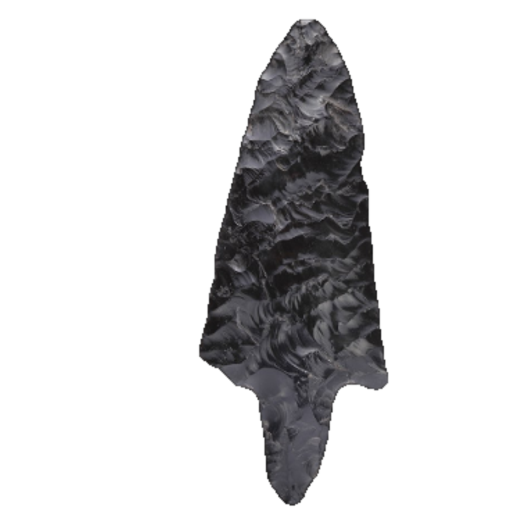
This triangular point exhibits a distinctive morphology, characterized by a medium to large size and a stout, elliptical cross-sectional profile. The blade edge displays a range of configurations, from straight to subtly excurvate, adding variability to its overall form. Notable features include barbed shoulders and a pronounced, convex base, which merges with a lengthy, contracting stem that typically comprises approximately one-third of the point's total length. The flaking pattern observed on this specimen is random, lacking a discernible, organized arrangement.
Size
The arrowhead's dimensions are as follows: it measures between 55 and 85 mm in length, with a stem that ranges from 12 to 17 mm in length. The blade itself spans 32 to 47 mm in width, while the stem is narrower, ranging from 8 to 13 mm in width. In terms of thickness, the arrowhead measures between 8 and 11 mm.
Distribution
This variant is documented in Cueva de la Nopalera, Hidalgo, Mexico. Such artifacts are believed to occur extensively across the Valley of Mexico.
Additional information
More information needed.
Identified by
- Named by
- Angel Garcia Cook
- Year
- 1967
- Type site
- Cueva de la Nopalera, Hidalgo
Similar types
Types that are easy to confuse with the Axolotl point.