
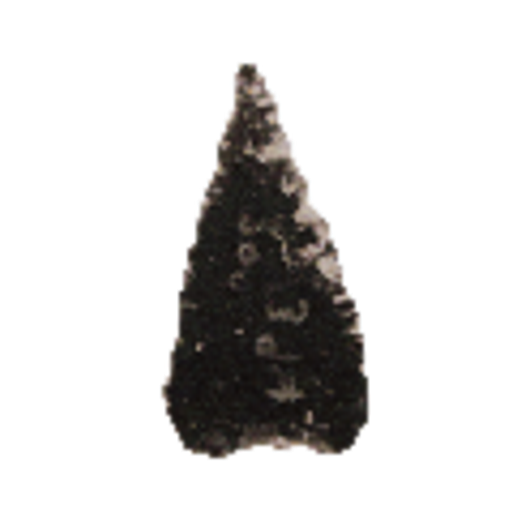
Arrowhead type
Tula Point
TulaLate Southern Triangle Cluster1,200 - 300 B.P.Late Classic to Postclassic3 reference photos
Key facts
- Age
- 1,200 - 300 B.P.
- Cultural period
- Late Classic to Postclassic
- Size
- Small
- Shape
- Triangle to Lanceolate
- Material
- Agate
- Glacial period
- Vandal Minimum to Little Ice Age
More from the Preclassic and Classic period
Description
This triangular point exhibits a slender profile, characterized by a symmetrical, isosceles shape and a cross-sectional morphology that transitions from elliptical to flattened. The blade's longitudinal profile varies, displaying a range of excurvate to straight configurations. The basal margin is distinctly concave. Fabricated from a polyhedral core, the point was produced by striking a prismatic blade, which was subsequently refined through meticulous fine pressure flaking. The resulting flaking pattern appears random, lacking a discernible, organized arrangement.
Size
The arrowheads exhibit a range of dimensions, with overall lengths spanning 18 to 33 millimeters, averaging 25 millimeters. In terms of width, they measure between 7 and 19 millimeters, with a mean width of 12 millimeters. The thickness of these artifacts varies from 1.5 to 4 millimeters, with an average thickness of 2 millimeters.
Distribution
This variety is documented in Tehuacan Valley and the Valley of Mexico. MacNeish notes that this variety occurs extensively across Meso-America
Mainly found in
Additional information
More information needed.
Identified by
- Named by
- Richard "Scotty" MacNeish
- Year
- 1962
Similar types
Types that are easy to confuse with the Tula point.
Other types in the Late Southern Triangle Cluster
- Teotihuacan