
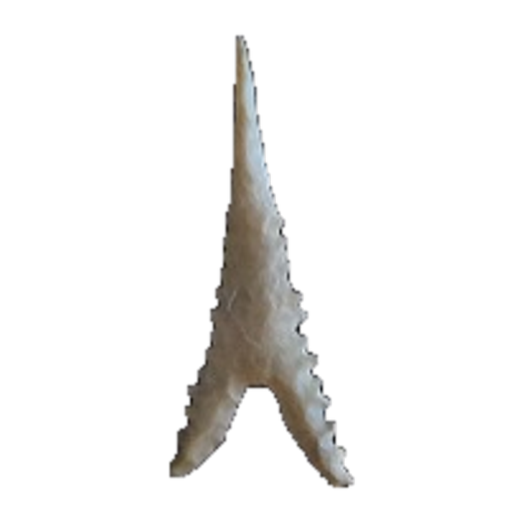
Arrowhead type
Garza Point
GarzaLate Southern Triangle Cluster500 to 350 B.P.Late Prehistoric to Classic14 reference photos
Key facts
- Age
- 500 to 350 B.P.
- Cultural period
- Late Prehistoric to Classic
- Size
- Small
- Shape
- Triangle to Basal Notch
- Material
- Obsidian
- Glacial period
- Little Ice Age
More from the Late Prehistoric, Preclassic and Classic periods
Description
This slender, triangular point exhibits a compressed cross-sectional profile. Its blade morphology ranges from straight to recurvate, often characterized by a pronounced flare at the basal margin. The edge retouch varies, featuring either serrations or small, shallow notches confined to the medial section of the blade. The base is distinguished by a concave shape and a central basal notch. Notably, despite the prevalence of uni-facial examples, this point typically displays a high level of craftsmanship. The flaking pattern is irregular, lacking a discernible pattern, and is often characterized as random.
Size
The dimensions of the arrowheads are characterized by a total length ranging from 15 to 45 mm and a basal width spanning from 9 to 18 mm.
Distribution
This type is mainly discovered in the western parts of Texas, including the Trans Pecos and Big Bend areas, extending north to Lamb and Bailey counties, and west to Donna Ana and Otero counties in New Mexico. It can also be located in southwestern Oklahoma, albeit less commonly
Mainly found in
Additional information
In the realm of Native American arrowhead studies, a particular point of interest has been identified as a variant of the Toyah point, a classification initially proposed by Turner and Heater in 1985. This distinctive arrowhead type was formally named the Soto Point by Alan Phelps, a renowned member of the El Paso Archaeological Society, in 1968. Notably, the Soto Point designation has also been applied to certain Garza points discovered in New Mexico and Chihuahua, Mexico, highlighting the complexities of archaeological classification. A closer examination of the Soto Point reveals that certain specimens, as illustrated in Pictures 1 and 3, exhibit characteristics consistent with the Revilla type, a sub-type recognized by collectors. This observation underscores the importance of meticulous analysis and classification in understanding the diversity and distribution of Native American arrowhead types.
Identified by
- Named by
- Frank A. Runkles
- Year
- 1964
- Type site
- Garza Site (near town of Post), Garza County, Texas
Similar types
Types that are easy to confuse with the Garza point.
Other types in the Late Southern Triangle Cluster
- Revilla