
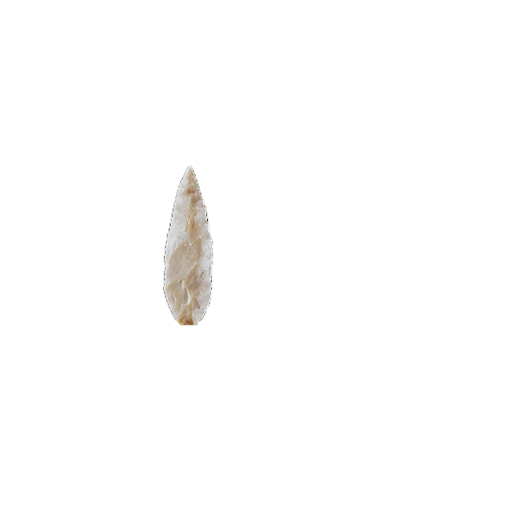
Arrowhead type
Thrall Point
Thrall8,800 - 8,100 B.P.Early Archaic7 reference photos
Key facts
- Age
- 8,800 - 8,100 B.P.
- Cultural period
- Early Archaic
- Size
- Medium to Large
- Shape
- Straight Stem to Lanceolate
- Glacial period
- Early Holocene
More from the Archaic period
Description
This stemmed lanceolate point exhibits a distinctive elliptical profile, with a medium to large size range. The blade's excurvate shape is characterized by a gentle curvature that converges at the tip, while its edges run parallel to each other. Notably, the shoulder is either barely perceptible or absent, and when present, it forms an upward angle. The stem is robust and straight, with a base that displays a subtle to pronounced concavity. The stem's length is considerable, comprising approximately one-third to one-half of the point's overall length. Characteristic of this type is the presence of extensive grindings on the base and hafting area, indicating significant wear. The flaking pattern on this point can exhibit a range of styles, from random to horizontally oriented or parallel oblique, showcasing the variability in manufacturing techniques.
Size
The dimensions of the arrowheads are as follows: they range in length from 50 to 105 mm, with blade widths spanning 18 to 42 mm, and exhibit an average thickness of 9 mm.
Distribution
This type is mainly located in the heart of Texas.
Mainly found in
Additional information
In the realm of Native American arrowhead typology, a distinctive point style has been identified, bearing a resemblance to the coastal Victoria type, yet distinguished by the absence of an expanding stem. This characteristic has led researchers, including Perttula (2004), to propose that this point may represent a regional variation of the Victoria type, specifically adapted to the central Texas context. The Thrall type, as it is known, is predominantly found in central Texas, whereas the Victoria and Zella types are more commonly associated with the coastal and coastal plains regions.
The spatial distribution of these point types has significant implications for our understanding of their temporal relationships. Notably, sites containing both the Thrall and Victoria or Zella types have not been discovered, leaving the chronological positioning of these types uncertain. However, stratigraphic analysis has revealed that the Thrall type is often found in levels above those containing Angostura points, suggesting that the Thrall type may be slightly more recent than the Victoria type, which is typically found in the same levels as Angostura points. This observation has led many researchers to consider the Thrall type as a variant of the Angostura type, with some opting to hyphenate the name as Angostura-Thrall.
Interestingly, alternative classifications have also been proposed, highlighting the complexities of arrowhead typology. For instance, Waters and Jennings (2015) have suggested that the Thrall type may be more accurately classified as a variant of the Hell Gap type, leading them to hyphenate the name as Hell Gap-Thrall. This diversity of opinion underscores the ongoing refinement of our understanding of Native American arrowhead types, including the Texas Angostura types, and underscores the need for continued research and analysis to clarify the relationships between these distinctive point styles.
Identified by
- Named by
- Frank A. Weir
- Year
- 1984
- Type site
- Wilson-Leonard Site (41WM235), Williamson County, Texas
Similar types
Types that are easy to confuse with the Thrall point.
Other types in this cluster
- Levi
- St Mary's Hall
- Zella