
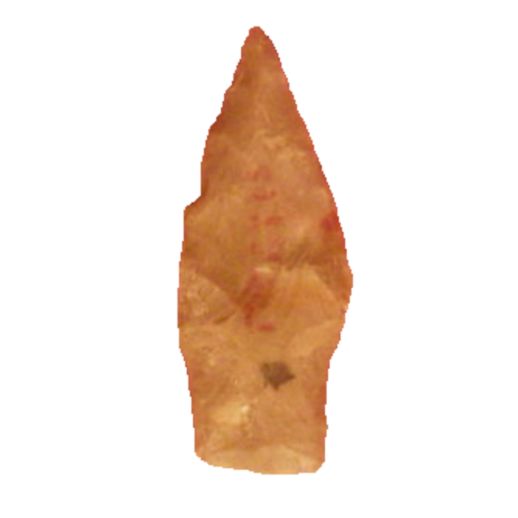
Arrowhead type
Travis Point
Travis4,600 - 4,000 B.P.Middle Archaic18 reference photos
Key facts
- Age
- 4,600 - 4,000 B.P.
- Cultural period
- Middle Archaic
- Size
- Medium
- Shape
- Straight Stem
- Material
- Pottery
- Glacial period
- Neoglacial
More from the Archaic period
Description
This medium-sized, lanceolate point features a stemmed design with an elliptical profile. Its slender blade is characterized by a lengthy, narrow shape, often exhibiting an excurvate form where the edge curves inward toward the shoulders. Alternatively, some specimens display a straight blade configuration. The shoulders themselves vary in definition, ranging from subtle to pronounced, and are positioned at an upward angle with rounded tips. The stem is notably long, with a shape that can be either straight or slightly flared outward. Notably, this point type lacks evidence of basal or hafting region grinding and smoothing. The base of the point is straight, with basal corners that are rounded. The flaking pattern observed on this point is random, without a discernible, consistent pattern.
Size
The arrowheads exhibit a range of dimensions, with overall lengths spanning 45 to 90 mm, and an average length of 70 mm. The stem, which comprises approximately 1/5 to 1/3 of the total length, measures between 15 and 20 mm. In terms of width, the arrowheads range from 20 to 25 mm, while the stem width varies from 15 to 20 mm.
Distribution
This type is mainly located in the central region of Texas. It can also be discovered, albeit less often, in the lower Pecos area and extending into southern Oklahoma
Additional information
In the realm of Native American archaeology, the Travis point is a notable arrowhead type that has undergone significant scrutiny and reclassification over the years. Initially described by J. Charles Kelley in 1947 as the Straw Stem point, this artifact was later redefined by Suhm, Krieger, and Jelks in 1954, who coined the term "Travis point" in reference to specimens discovered in central Texas. Further research by F.A. Weir in 1979 led to the identification of a similar point, known as the Buda point, which is believed to be a local variant found in Hays County, Texas, and cataloged as W11.
A comparative analysis of the Travis point reveals distinct differences from other arrowhead types. Notably, it lacks the beveling and stem grinding characteristic of the Darl point, setting it apart from this similar yet distinct artifact. Additionally, the Travis point can be distinguished from the Nolan point by the absence of beveling on its stem edge. When compared to the Lange point, the Travis point is narrower and lacks the prominent shoulders that are a hallmark of the latter. These subtle yet significant variations underscore the importance of meticulous classification and analysis in the field of archaeology.
The Travis point's unique characteristics and distribution provide valuable insights into the cultural and technological practices of Native American communities in central Texas. As a distinct arrowhead type, it contributes to our understanding of the region's prehistoric record, highlighting the diversity and complexity of indigenous cultures. By examining the Travis point within the context of other arrowhead types, researchers can gain a deeper appreciation for the nuances of Native American technology and the regional variations that defined their material culture.
Identified by
- Named by
- Dee Ann Suhm
- Year
- 1954
Similar types
Types that are easy to confuse with the Travis point.