
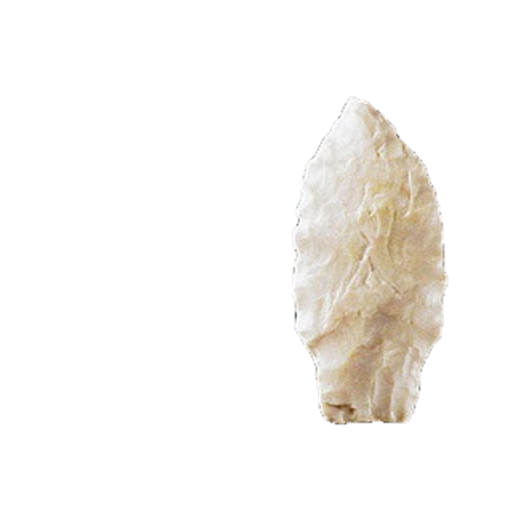
Arrowhead type
Early Stemmed Lanceolate Point
Early Stemmed Lanceolate9,000 - 8,000 B.P.Transitional Paleo to Early ArchaicKey facts
- Age
- 9,000 - 8,000 B.P.
- Cultural period
- Transitional Paleo to Early Archaic
- Size
- Medium to Large
- Shape
- Straight Stem to Contracting Stem
- Glacial period
- Early Holocene
Description
This expanding stem point exhibits a medium to large size profile, characterized by an elliptical cross-sectional shape. The blade morphology is typically marked by an excurvate shape, where the edges curve outward at the distal end, while the lateral margins remain parallel. In some instances, the blade assumes a straight configuration. The shoulders are either faintly defined or absent, and when present, are positioned at an upward inclination. The stem displays a range of forms, from straight to slightly expanding, and the basal edge varies between concave and straight. The flaking pattern on these points can exhibit a range of characteristics, from random to parallel oblique, reflecting variability in the reduction strategy employed during their manufacture.
Size
The dimensions of the arrowheads are characterized by the following measurements: overall length ranges from 25 to 95 mm, with a mean length typically falling between 50 to 65 mm. The stem, which connects the blade to the shaft, measures between 10 to 20 mm in length. The blade itself is 15 to 25 mm in width, averaging approximately 20 mm. Additionally, the width of the stem is recorded to be between 12 to 18 mm.
Distribution
This type is mainly discovered in the Pecos area and extends into southern and central Texas. This type may also appear in southern Oklahoma, albeit less commonly.
Additional information
The classification and chronology of this particular arrowhead type have been subjects of ongoing discussion among archaeologists, with notable contributions from Turner and Hester in 1985. A key point of contention revolves around the dating of this type, highlighting the need for further typological research to establish a definitive characterization. Despite this uncertainty, some researchers, such as Kelley in 1983, have suggested that the variations observed in this type fall within the expected range of normal variation. Consequently, Kelley has tentatively grouped this type alongside the Victoria type, acknowledging the need for continued investigation to refine our understanding of its place within the broader context of Native American arrowhead typology.
The ongoing debate surrounding the dating and classification of this arrowhead type underscores the complexities inherent in the study of archaeological artifacts. The fact that multiple researchers have weighed in on the issue, with differing opinions on its chronology and typological significance, serves as a testament to the nuanced and multifaceted nature of archaeological inquiry. As our understanding of Native American cultures and their material remains continues to evolve, it is likely that further research will shed new light on the characteristics and significance of this particular arrowhead type, ultimately informing a more comprehensive appreciation of the technological, cultural, and historical contexts in which it was created and used.
The tentative inclusion of this type within the Victoria type, as proposed by Kelley, suggests that there may be meaningful connections between the two, potentially reflecting shared cultural, technological, or historical factors. However, the need for additional typological research, as emphasized by Turner and Hester, highlights the importance of rigorous and systematic analysis in establishing a robust and accurate understanding of this arrowhead type. By continuing to investigate and refine our knowledge of this type, archaeologists can gain valuable insights into the lives and traditions of the Native American communities that created and utilized these artifacts, ultimately enriching our appreciation of the rich and diverse cultural heritage of North America.
Identified by
- Named by
- Elias H. Sellards and Glen L. Evans
- Year
- 1940
- Type site
- Berclair Terrace, Bee County, Texas
Similar types
Types that are easy to confuse with the Early Stemmed Lanceolate point.
- Angostura
- Darl Stemmed
- Pontchartrain
- Victoria
- Zephyr
Other types in this cluster
- Golondrina