
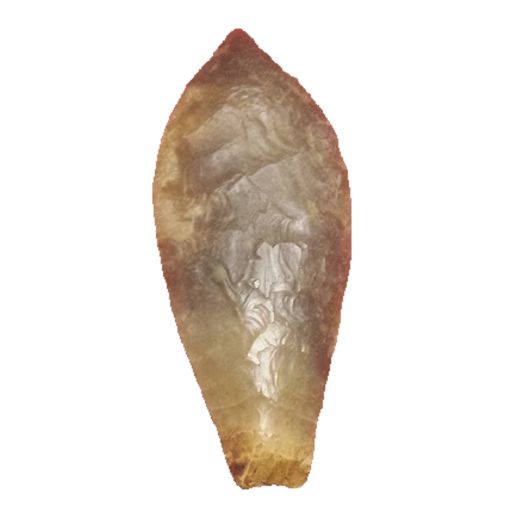
Arrowhead type
Victoria Point
Victoria8,800 - 8,100 B.P.Transitional Paleo7 reference photos
Key facts
- Age
- 8,800 - 8,100 B.P.
- Cultural period
- Transitional Paleo
- Size
- Medium to Large
- Shape
- Straight Stem to Contracting Stem to Lanceolate
- Glacial period
- Early Holocene
More from the Paleo period
Description
This stemmed lanceolate point exhibits a distinctive morphology, characterized by a medium to large size and an elliptical cross-sectional profile. The blade itself is marked by an excurvate shape, where the edges converge at the tip, while the lateral margins remain parallel. The shoulder is either subtly defined or virtually absent, and is positioned at an upward inclination. The stem displays variability in its outline, ranging from a straight configuration to one that expands towards the base. The basal portion of the point is notable for its concavity, which can range from slight to more pronounced, and may also feature evidence of basal thinning or grinding. In terms of flaking patterns, oblique parallel flaking is the predominant technique observed, although random flaking is also a common occurrence. Less frequently encountered is the horizontal transverse flaking pattern, which adds to the typological diversity of this point style.
Size
The dimensions of the arrowheads are as follows: they range in length from 50 to 105 mm, with the stem portion measuring between 18 and 23 mm, most typically 20 mm. The blade itself spans 18 to 42 mm in width, while the basal width is between 11 and 15 mm. On average, the thickness of the arrowheads is 9 mm.
Distribution
This type is mainly discovered in eastern and southern central Texas and extending into the Coastal Plains area..
Mainly found in
Additional information
In the realm of Native American archaeology, the Victoria Angostura point holds significant interest, particularly in the Coastal Plains region of Texas. This distinctive arrowhead type was first identified by Birmingham and Hester in 1976, who coined the term "Victoria Angostura" based on their discoveries in this area. Further research conducted by Thomas Kelly in 1983 delved deeper into the characteristics of Angostura points found in central to coastal Texas, with a primary focus on McMullen County. Kelly's analysis yielded a nuanced understanding of the Angostura point, revealing three distinct variants that warrant individual recognition.
These variants, as defined by Kelly, include the Texas Angostura, Victoria Angostura, and Zella Angostura, each with its own unique attributes. This categorization underscores the diversity within the Angostura point type, highlighting the complexity of Native American lithic technology in the region. By examining the specific characteristics of each variant, researchers can gain a deeper understanding of the cultural and historical contexts in which they were crafted and utilized. The identification of these variants also underscores the importance of meticulous analysis and classification in archaeological research, as it enables a more precise understanding of the lives and traditions of the people who created these artifacts.
The study of Angostura points, including the Victoria Angostura and its variants, offers valuable insights into the lives of Native American communities in Texas, particularly during the time periods in which these points were manufactured and used. By continuing to explore and refine our understanding of these artifacts, archaeologists can reconstruct a more detailed and nuanced picture of the region's cultural heritage, shedding light on the technological, social, and economic aspects of Native American societies in the Coastal Plains region of Texas.
Identified by
- Named by
- William "Bill" W. Birmingham and Thomas. R. Hester
- Year
- 1976
Similar types
Types that are easy to confuse with the Victoria point.