
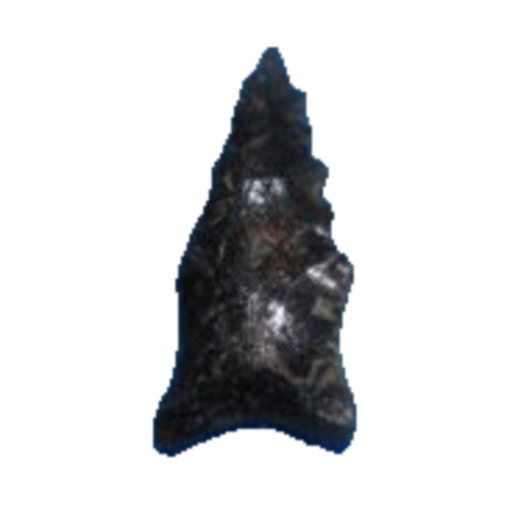
Arrowhead type
San Jose Point
San JoseSan Jose Cluster5,300 - 3,800 B.P.Middle Archaic10 reference photos
Key facts
- Age
- 5,300 - 3,800 B.P.
- Cultural period
- Middle Archaic
- Culture
- Oshara Tradition
- Size
- Small to Medium
- Shape
- Expanding Stem to Side Notch
- Glacial period
- Middle Holocene
More from the Archaic period
Description
This point exhibits a compact to moderate size, characterized by a cross-sectional profile that transitions from flat to elliptical. The blade morphology varies, spanning from excurvate to straight configurations. A distinctive feature of these points is the prevalence of short, serrated blades. The shoulders are typically subdued or virtually absent, sloping upward toward the apex. The stem displays a range of forms, from straight to expanding, with the latter being more prevalent. Notably, the base is concave and features basal grinding that extends onto the stem. A characteristic proportion of these points is that the stem's width is roughly equivalent to its length. In terms of manufacture, primary percussion flaking is employed, often overlaid by secondary pressure flaking that can obscure the initial flaking pattern, resulting in a random, multi-directional flaking arrangement.
Size
The arrowheads exhibit a range of dimensions, with total lengths spanning 17 to 55 mm, and averaging between 33 to 38 mm. The stem length typically falls within a narrower range of 9 to 15 mm, and is characterized by a blade to stem ratio of approximately 1:1.3. In terms of blade width, measurements vary from 11 to 27 mm, with an average width of 20 mm. The basal width ranges from 13 to 23 mm, while the thickness of the arrowheads is consistently between 5 to 8 mm.
Distribution
This style is mainly discovered in the central Rio Grande River valley and extending into the Uncompahgre Plateau, Colorado Plateau and the Great Basin. This variety was identified at the La Playa site in northern Sonora, Mexico
Mainly found in
Additional information
In the realm of Native American arrowheads, a distinctive point type exhibits characteristics that set it apart from its counterparts, notably the McKean point. One of the primary distinguishing features of this point is its relatively shorter stem, which is complemented by a concaved base. This unique combination of traits allows archaeologists to identify and categorize these points with a greater degree of accuracy. Interestingly, these points are often found in association with Bajada points, as noted by Justice in 2002, suggesting a potential cultural or temporal link between the two types.
The distribution of these points is largely confined to specific regions, with no reported presence in the plains area. However, it is essential to exercise caution when encountering points in this region, as they can be easily mistaken for re-sharpened Dalton points. This potential for confusion highlights the importance of meticulous analysis and consideration of contextual factors when attempting to identify and classify arrowhead types. By recognizing these nuances, researchers can gain a deeper understanding of the cultural and historical contexts in which these points were created and used.
The work of Justice (2002) provides valuable insights into the characteristics and distribution of these points, underscoring the significance of continued research and documentation in the field of archaeology. By examining the distinctive features and associations of these points, scholars can refine their understanding of Native American cultures and technologies, ultimately shedding light on the complex and fascinating history of human presence in North America. Through careful study and analysis, archaeologists can continue to uncover new information and refine their knowledge of these enigmatic artifacts, ultimately enriching our appreciation for the ingenuity and craftsmanship of Native American communities.
Identified by
- Named by
- Cynthia Irwin-Williams
- Year
- 1973
- Type site
- Arroyo Cuervo Valley, New Mexico
Similar types
Types that are easy to confuse with the San Jose point.