
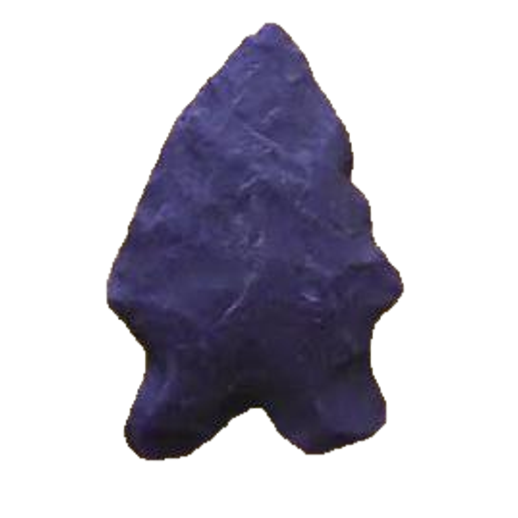
Arrowhead type
Chiricahua Point
ChiricahuaNorthern Side Notch Cluster4,800 - 2,500 B.P.Late ArchaicKey facts
- Age
- 4,800 - 2,500 B.P.
- Cultural period
- Late Archaic
- Size
- Small to Medium
- Shape
- Side Notch to Bifurcated
- Material
- Obsidian
- Glacial period
- Neoglacial
More from the Archaic period
Description
This triangular side notch point exhibits a compact to medium size, characterized by a cross-sectional profile that transitions from elliptical to flattened. The blade's curvature can range from excurvate to straight, with heavily resharpened specimens often displaying reduced blade lengths. The parallel notches are typically shallow and C-shaped, resulting in a broad neck and shoulders that can be oriented horizontally or at an upward angle. Notch placement on the preform varies, occurring anywhere from low to high positions. The stem expands outward, featuring a rounded basal edge that is generally wider than the blade itself. The base is concave, giving rise to distinctive basal ears. The flaking pattern on this point is random, lacking a consistent or organized arrangement.
Size
The dimensions of these arrowheads are characterized by the following measurements: overall length ranges from 20 to over 75 mm, with an average length typically falling between 20 to 25 mm, although worn specimens can be substantially shorter. The stem measures between 6 and 15 mm in length. The blade width varies from 12 to 22 mm, commonly ranging from 17 to 18 mm. The neck width is between 9 and 18 mm, while the basal width spans from 11 to 22 mm. In terms of thickness, these arrowheads measure between 4 and 8 mm.
Distribution
This type is mainly located on the Coconino Plateau, and in the Mexican regions of Chihuahua and northern Sonora, as well as northwestern Chihuahua. It can also be discovered in southwestern New Mexico and southeastern California, albeit less commonly.
Mainly found in
Also found, less often, in
Additional information
In a critical reevaluation of archaeological classifications, Justice (2002) highlights the need for a revised definition of a specific point type, citing concerns that its characteristics have been inadequately distinguished. Notably, the described features of this point exhibit significant overlap with those of the San Jose point, leading to considerable confusion among researchers. To address this issue and clarify the typology, Justice proposes a redefinition of the point in question, ultimately recommending its reclassification as the Ventana Side Notch. This revision aims to mitigate the confusion stemming from the point's previously ambiguous definition, thereby enhancing the precision and accuracy of archaeological classifications. By reexamining and refining the characteristics of this point, Justice's work contributes to a more nuanced understanding of the archaeological record, underscoring the importance of ongoing critical evaluation and refinement in the field.
Identified by
- Named by
- Herbert W. Dick
- Year
- 1965
- Type site
- Bat Cave, New Mexico
Similar types
Types that are easy to confuse with the Chiricahua point.
- Abiquiu
- Elko Eared
- La Playa
- San Jose
- Squaw Mountain
- Ventana Side Notch