
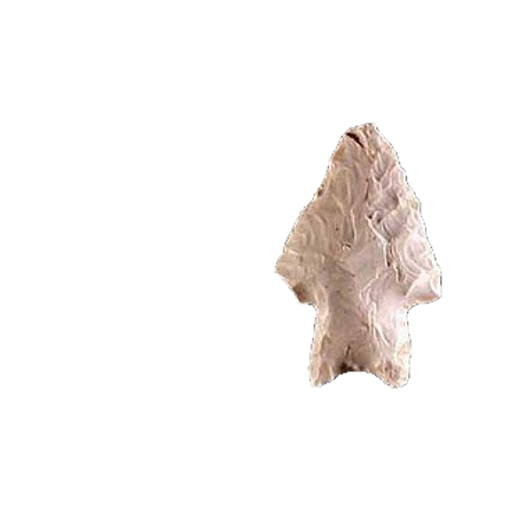
Arrowhead type
Baker Point
Baker8,000 - 6,000 B.P.Early Archaic5 reference photos
Key facts
- Age
- 8,000 - 6,000 B.P.
- Cultural period
- Early Archaic
- Size
- Small to Medium
- Shape
- Straight Stem to Bifurcated
- Glacial period
- Middle Holocene
More from the Archaic period
Description
This triangular point exhibits a distinctive morphology, characterized by a medium to small size and an elliptical profile. The blade edge displays variability, ranging from a straight alignment to a gently curved, excurvate shape. The shoulder morphology is typically marked by a horizontal orientation, although some specimens may exhibit a subtle barbing or a slight, upward inclination. As the tool underwent re-sharpening, the shoulders and blade length were progressively reduced. The stem, which expands in width, is often accompanied by a concave or bifurcated basal configuration. The flaking pattern observed on this point is random, lacking a discernible, organized arrangement.
Size
The arrowheads exhibit a range of dimensions, with overall lengths spanning 25 to 55 mm. The stem, which typically comprises between one-third to one-half of the total length, measures between 10 to 18 mm. The blade itself is 15 to 35 mm in width, while the neck and basal widths are 10 to 20 mm and 13 to 20 mm, respectively.
Distribution
This type is mainly discovered in the westernmost part of Texas, extending into New Mexico, and northern Mexico
Mainly found in
Additional information
The final two specimens illustrated in this collection are notable for their distinctive characteristic: blades that have been entirely utilized, leaving no remaining usable edge. These points, having been thoroughly exploited, offer a fascinating glimpse into the resourcefulness and thriftiness of their Native American creators. The fact that these blades were used to the point of exhaustion underscores the importance of conservation and reuse in the daily lives of these ancient cultures.
It is worth noting that the presence of exhausted blades in archaeological assemblages can provide valuable insights into the technological and economic strategies employed by Native American groups. The careful management of lithic resources, as evidenced by the exhaustive use of these blades, highlights the ingenuity and adaptability of these communities. Furthermore, the study of such specimens can shed light on the complex relationships between tool use, resource availability, and cultural practices in Native American societies.
The examination of these exhausted blades also invites consideration of the broader cultural context in which they were used. By analyzing the forms, materials, and degrees of utilization of such artifacts, researchers can reconstruct aspects of the technological, social, and economic organization of Native American groups, ultimately deepening our understanding of their daily lives and cultural traditions.
Identified by
- Named by
- James A Word and Charles C. Douglas
- Year
- 1970
- Type site
- Baker Cave Site, Val Verde County, Texas
Similar types
Types that are easy to confuse with the Baker point.