
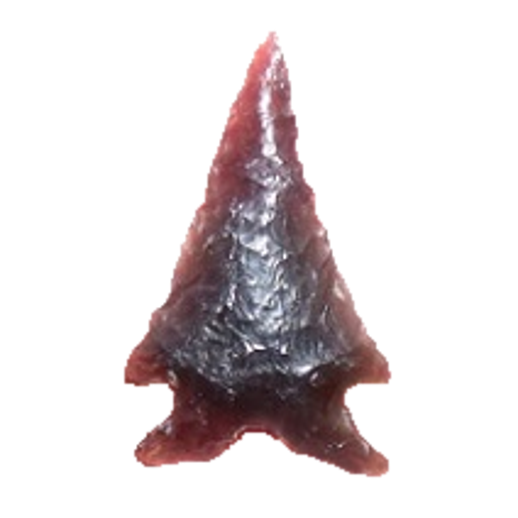
Arrowhead type
Elko Eared Point
Elko EaredElko Corner Notch Cluster3,500 - 1,400 B.P.Late Archaic to Transitional Archaic21 reference photos
Key facts
- Age
- 3,500 - 1,400 B.P.
- Cultural period
- Late Archaic to Transitional Archaic
- Size
- Small to Medium
- Shape
- Expanding Stem to Bifurcated
- Material
- Obsidian
- Glacial period
- Neoglacial to Roman Warm
More from the Archaic period
Description
This triangular side-notched point exhibits a distinctive morphology, characterized by a compact to medium size and a cross-sectional profile that transitions from flattened to elliptical. The blade's curvature can vary, ranging from a subtle excurvate shape to a straight edge, and often features fine serrations along its length. The shoulders of the point can display a range of orientations, from a horizontal alignment to a more angled, upward-sloping position. The stem expands outward, terminating in a base that is either straight or subtly concave. In terms of flaking patterns, this point typically displays a random arrangement of flakes, although some specimens may exhibit a more organized, parallel-oblique pattern.
Size
The dimensions of these arrowheads are characterized by the following measurements: overall length ranges from 24 to 68 mm, with a mean length of 33 to 51 mm. The stem measures between 7 and 11 mm in length. The blade width varies from 15 to 52 mm, averaging between 18 and 24 mm. The neck width spans 11 to 32 mm, commonly falling within the range of 13 to 17 mm. The basal width is between 13 and 42 mm, typically 10 to 20 mm narrower than the blade width. The thickness of the arrowheads is between 4 and 9 mm.
Distribution
This arrowhead type is distributed across the Great Basin region, extending into the Snake River Valley and southeastern Oregon's Klamath Valley. It also appears in the northern section of the Colorado Plateau. The range stretches westward to the Sacramento River Valley. Additionally, it reaches southward into northern Baja California and northwestern Sonora, Mexico
Also found, less often, in
Additional information
The origins of Elko Eared points are believed to have stemmed from eastern regions, with their use gradually spreading westward over time. These distinctive arrowheads were employed across a considerable time span, from the Archaic phase to the Fremont culture, with their functionality evolving from darts in earlier periods to potential use as knives in later times. Notably, Elko Eared points precede the emergence of Elko Corner Notch points, with their usage peaking before that of the latter. This chronological pattern is evident at sites such as Shallow Shelter, where excavations have revealed a concentration of Elko Eared points in the same stratigraphic layer as Pinto points, while Elko Corner Notch points are more prevalent in the overlying layers.
However, it is essential to acknowledge that this temporal distinction is not universally observed, as evidenced by sites like Gatecliff Shelter, where no significant chronological difference between the two point types has been detected (Justice, 2002). This discrepancy suggests that Elko Eared and Elko Corner Notch points may represent a technological continuum, making it challenging to distinguish between the two types. Both types often exhibit a concaved base, but researchers have relied on subtle differences to categorize them. Thomas (1981) proposed a method for distinguishing between the two, based on the depth of the concaved base, measured by the indentation ratio. According to this criteria, points with an indentation ratio of 0.93 or less are classified as Elko Corner Notch, while those with a ratio greater than 0.93 are considered Elko Eared.
The nuanced differences between Elko Eared and Elko Corner Notch points underscore the complexity of archaeological classification and the need for careful analysis. By examining the stratigraphic context, technological characteristics, and morphological features of these points, researchers can gain a deeper understanding of the cultural and temporal dynamics that shaped the lives of ancient Native American communities. The study of these arrowheads not only provides insights into the technological advancements and adaptations of these societies but also highlights the importance of contextualizing archaeological findings within the broader framework of human history and cultural development.
Identified by
- Named by
- Robert F. Heizer and Martin A. Baumhoff
- Year
- 1961
- Type site
- South Fork Shelter, Elko County, Nevada
Similar types
Types that are easy to confuse with the Elko Eared point.
- Eastgate Split Stem
- Hells Canyon
- Jalama
- La Jolla
- Merrybelle
- Snake River
Other types in the Elko Corner Notch Cluster
- Amargosa
- Elko Corner Notch
- Elko Side Notch
- Elko Split Stem