
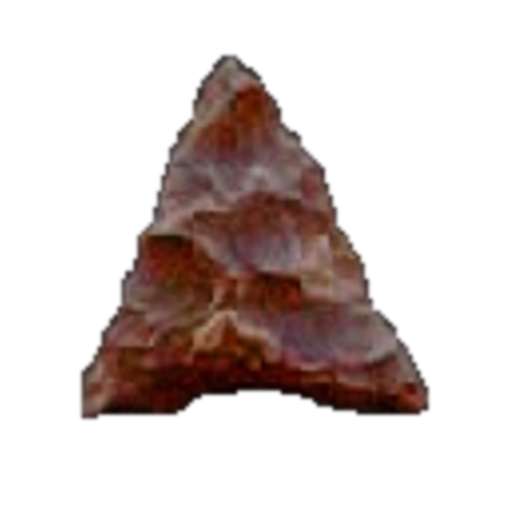
Arrowhead type
Pisgah Point
PisgahLate Woodland Triangle Cluster to Early Mississippian Triangle Cluster900 - 500 B.P.MississippianKey facts
- Age
- 900 - 500 B.P.
- Cultural period
- Mississippian
- Culture
- Cherokee Culture
- Size
- Small
- Shape
- Triangle
- Material
- Quartz
- Glacial period
- Medieval Warm to Little Ice Age
More from the Mississippian period
Description
This slender, triangular point exhibits a compressed cross-sectional profile. Its blade morphology ranges from straight to subtly curved, occasionally featuring serrations along its edge. The point's shape can be characterized as either isosceles, with a width roughly half its height, or equilateral, where the width and height are approximately equal. The basal edge is typically straight or mildly convex, although occasional specimens display a slightly concave base.
The point is often fabricated from a flake, resulting in variable flaking patterns that can be either bi-facial or uni-facial, with some surfaces remaining unflaked. While certain examples demonstrate meticulous craftsmanship, many others appear crudely made, bearing irregular flaking patterns that suggest a lack of refinement in their production.
Size
The dimensions of the arrowheads are as follows: they range in length from 16 to 30 millimeters, with a mean length of 25.4 millimeters, and in width from 11 to 21 millimeters, with a mean width of 15 millimeters, as reported by Dickenson in 1976.
Distribution
This type is mainly discovered in the mountainous peak area of North Carolina and South Carolina, Georgia, and Tennessee
Mainly found in
Additional information
In his 1976 study, Dickens observes that the arrowhead points in question share a striking resemblance to other triangular forms that emerged during the Late Woodland to Mississippian period in the Eastern Woodlands. Notably, these points exhibit a strong morphological affinity with the Dallas Triangular points, which were unearthed at archaeological sites in eastern Tennessee, specifically those associated with the Dallas culture. This similarity highlights the challenges of distinguishing between these point types, as they appear to have been crafted using comparable techniques and design principles. The overlap in their morphological characteristics underscores the need for a nuanced understanding of the cultural and temporal contexts in which these points were produced, in order to accurately interpret their significance and provenance.
The Dallas Triangular points, which serve as a useful reference point for comparison, are characterized by their distinctive triangular shape and are typically dated to the Mississippian period. The fact that the points in question closely resemble these Dallas Triangular points suggests that they may have been crafted during a similar time frame, potentially indicating cultural exchange or technological diffusion between the Eastern Woodlands and the Dallas culture. Further analysis of the points' morphology, materials, and archaeological context is necessary to shed more light on their origins and significance.
The observation that these points are indistinguishable from other triangular forms of the Late Woodland to Mississippian period underscores the complexity of the archaeological record in the Eastern Woodlands. As researchers, it is essential to consider the broader cultural and historical context in which these points were created, taking into account the social, economic, and technological factors that may have influenced their design and production. By adopting a more holistic approach to the study of these arrowhead points, we can gain a deeper understanding of the lives and traditions of the Native American communities that crafted them, and shed more light on the rich cultural heritage of the Eastern Woodlands.
Identified by
- Named by
- Bennie Keel and Roy Dickens
- Year
- 1972
Similar types
Types that are easy to confuse with the Pisgah point.