
Arrowhead type
Pinellas Point
PinellasLate Woodland Triangle Cluster to Early Mississippian Triangle Cluster700 - 400 B.P.Late Mississippian to Historic13 reference photos
Key facts
- Age
- 700 - 400 B.P.
- Cultural period
- Late Mississippian to Historic
- Culture
- Safety Harbor, Alachua, St. Johns Cultures
- Size
- Small to Medium
- Shape
- Triangle to Lanceolate
- Glacial period
- Little Ice Age
More from the Mississippian, Historic periods
Description
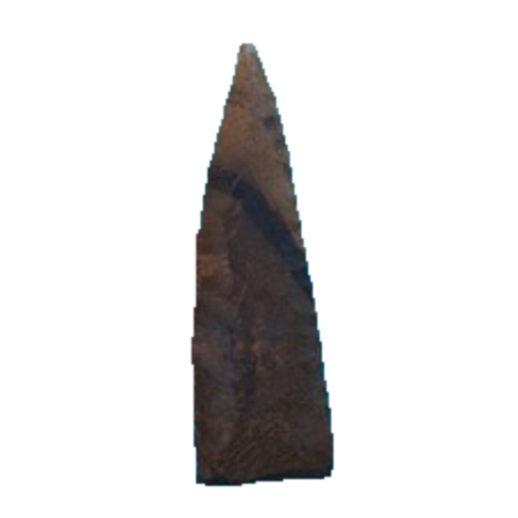
This diminutive, triangular projectile exhibits a cross-sectional profile that ranges from flattened to elliptical, often transitioning to a plano-convex shape. The blade's morphology is predominantly straight, although some specimens display a subtle excurvate curvature, while a smaller subset exhibits an incurvate profile. A notable feature of many examples is the presence of delicate serrations along the blade's edge. In terms of overall geometry, the point typically forms an isosceles triangle, with a width that is roughly half its height. The base of the point is generally characterized by a straight to slightly concave margin, frequently accompanied by basal thinning. The manufacturing technique often involves utilizing flakes with one face fully flaked, while the opposing face features pressure flaking restricted to the edges, resulting in a uni-facial appearance.
Size
The dimensions of the arrowheads are characterized by a total length ranging from 15 to 55 mm, with a mean length typically falling between 25 and 35 mm. In terms of width, the measurements span from 10 to 25 mm, while the thickness varies from 2 to 6 mm.
Distribution
This type is mainly located in the northern parts of Florida, extending into the southern regions of Georgia and Alabama.
Additional information
In his 1953 publication, Goggin introduced a distinct style of arrowhead, which he termed the Timucua point, named after the indigenous Timucua culture of Florida. This classification is significant, as it highlights the unique characteristics of these points. A subsequent study by Bullen in 1975 further refined the distinction between Timucua points and other similar styles, such as the Ichetucknee and Tampa points. Notably, Bullen observed that Timucua points exhibit sharper basal corners, a distinctive feature that sets them apart from other comparable point styles.
A key characteristic of Timucua points is the absence of basal thinning, which is a notable difference from other points like the Ichetucknee and Tampa styles. This distinction is crucial in identifying and categorizing these arrowheads, allowing archaeologists to better understand the cultural and historical context in which they were created. The Timucua point style is an important part of the archaeological record, providing valuable insights into the technological and artistic traditions of the Timucua people, who inhabited Florida from around the 12th to the 18th centuries.
The work of Goggin and Bullen has been instrumental in shaping our understanding of Timucua points and their place within the broader context of Native American archaeology. By examining the unique characteristics of these points, researchers can gain a deeper appreciation for the cultural exchange, technological innovation, and artistic expression that defined the lives of the Timucua people. As archaeological research continues to uncover new information about these enigmatic points, our understanding of the Timucua culture and their contributions to the rich cultural heritage of Native America will only continue to grow.
Identified by
- Named by
- Ripley P. Bullen
- Year
- 1968
Similar types
Types that are easy to confuse with the Pinellas point.