
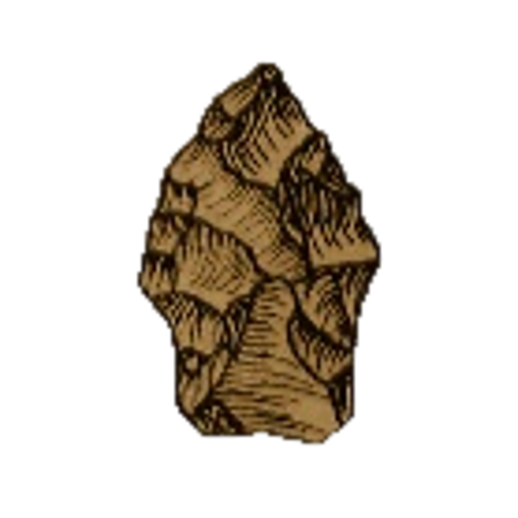
Arrowhead type
Dallas Point
Dallas3,000 - 1,300 B.P.Late to Transitional Archaic6 reference photos
Key facts
- Age
- 3,000 - 1,300 B.P.
- Cultural period
- Late to Transitional Archaic
- Size
- Small to Medium
- Shape
- Straight Stem
- Glacial period
- Neoglacial to Medieval Warm
More from the Archaic period
Description
This triangular stemmed point exhibits a compact to moderate size, typically measuring between 1.25 and 1.50 inches in length. Its cross-sectional profile is elliptical, while its overall silhouette can range from triangular to pentagonal in shape. The blade's curvature varies, spanning from straight to excurvate, with some specimens displaying a recurvate form that flares outward at the shoulder's edge. The shoulders themselves are subtly defined, often oriented horizontally or at a gentle upward angle. A proportionally lengthy stem characterizes this point, commonly straight in alignment but occasionally expanding slightly. The base of the point can be straight or convex, frequently featuring grinding in both the basal and hafting regions. The flaking pattern observed on this point is random, lacking a discernible order or orientation.
Size
The arrowhead's dimensions are characterized by a total length ranging from 35 to 50 mm. The stem, which typically comprises between one-third to one-half of the overall length, measures between 10 to 15 mm. In terms of width, the blade spans 15 to 20 mm, while the stem's width varies from 13 to 28 mm.
Distribution
This type is mainly discovered in northern parts of central Texas, particularly around the Dallas area. It can also be located, albeit less often, in southern areas of central Oklahoma
Additional information
In their 1954 publication, Suhm and Krieger raised an important question regarding the distinctiveness of a particular type of arrowhead, suggesting that it may not be sufficiently differentiated from the Elam point to justify its classification as a separate type. Upon examining specimens from the University of Texas, they observed that the characteristics of this point exhibited considerable overlap with those of the Elam point, with no discernible distinguishing features to set the two types apart. The primary basis for differentiation appears to be geographical distribution, rather than morphological characteristics.
Notably, this point is frequently found in conjunction with Carrolton points, with which it shares many similarities. However, a key difference between the two types is the absence of sharp shoulders on the Dallas point, a characteristic that is typically present on Carrolton points, as noted by Bell in 1958. This observation highlights the importance of careful analysis and comparison of archaeological artifacts to accurately understand their cultural and historical context.
The Dallas point's association with Carrolton points and its distribution patterns provide valuable insights into the cultural and geographical dynamics of the region. Further study of these points and their contexts can shed light on the technological, social, and economic interactions of the cultures that produced them, ultimately enriching our understanding of Native American archaeology and the lives of the people who created these artifacts. By examining the characteristics and distribution of the Dallas point, researchers can gain a more nuanced appreciation for the complexities of Native American cultural expression and the significance of these artifacts in the broader archaeological record.
Identified by
- Named by
- W. W. Crook and R. K. Harris
- Year
- 1954
Similar types
Types that are easy to confuse with the Dallas point.