
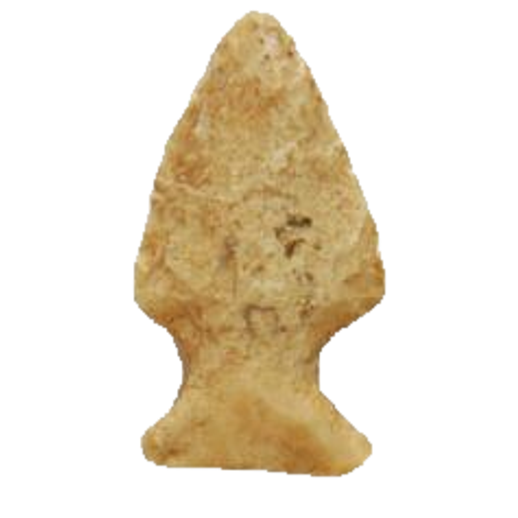
Arrowhead type
Tipton Point
TiptonMotley Cluster3,500 - 2,500 B.P.Late Archaic to Early WoodlandKey facts
- Age
- 3,500 - 2,500 B.P.
- Cultural period
- Late Archaic to Early Woodland
- Size
- Medium
- Shape
- Corner Notch to Side Notch to Expanding Stem
- Glacial period
- Neoglacial
Description
This triangular point exhibits a distinctive morphology, characterized by a stem with a corner notch and an elliptical profile. The blade edge can vary in curvature, ranging from straight to excurvate, while the shoulders display a range of orientations, from barbed to horizontal or angled upward. The notches are pronounced, creating a constricted neck that transitions into an expanding stem. The base of the point is typically straight, although some specimens feature a convex base. Notably, basal grinding is uncommon on this point type, and the flaking pattern is random, lacking a discernible order or orientation. Overall, the combination of these characteristics defines a medium-sized, triangular point with a unique set of attributes.
Size
Medium
Distribution
This type is predominantly located from northern to eastern Iowa. Such specimens can also be encountered, albeit less often, in southern Minnesota and southwestern Wisconsin
Also found, less often, in
Additional information
Upon examination, the arrowheads within this cluster exhibit certain characteristics reminiscent of the Snyders type, yet they are distinguished by a notably narrower neck (W2). A prominent representative of this cluster is the Motley point, which appears to be the most prevalent form. Notably, the Atalissa and Tipton points are considered to be regional variations of the Motley point, as suggested by Justice in 1987. This classification underscores the complex diversity within this cluster, highlighting the Motley point as a foundational type with localized expressions. The narrower neck measurement (W2) serves as a key diagnostic feature, setting these points apart from their Snyders counterparts and contributing to a more nuanced understanding of the archaeological record.
Identified by
- Named by
- Toby Morrow
- Year
- 1984
- Type site
- Various sites, Cedar County, Iowa
Similar types
Types that are easy to confuse with the Tipton point.
- Creston
- Dardanelle
- Durst
- Epps
- Table Rock