
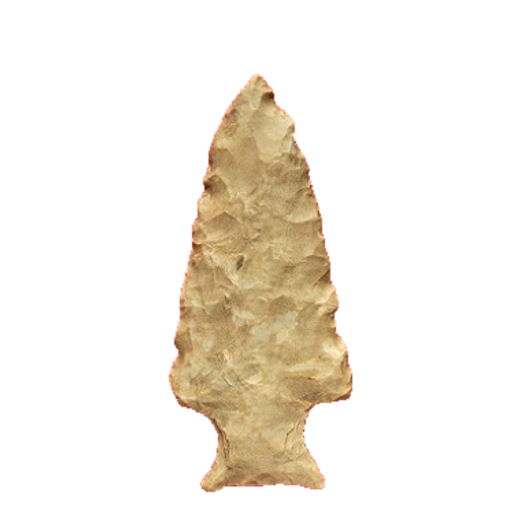
Arrowhead type
Normanskill Point
NormanskillLamoka Cluster4,300 - 3,300 B.P.Middle Archaic to Late Archaic8 reference photos
Key facts
- Age
- 4,300 - 3,300 B.P.
- Cultural period
- Middle Archaic to Late Archaic
- Culture
- Laurentian Tradition
- Size
- Medium to Large
- Shape
- Expanding Stem to Corner Notch to Side Notch
- Material
- Quartz
- Glacial period
- Neoglacial
More from the Archaic period
Description
This triangular point exhibits a sturdy, expansive stem and side notches, with a cross-sectional profile that is distinctly elliptical. The blade itself is characterized by a narrow width, displaying a range of curvature from straight to excurvate. Notably, the shoulders are well-defined and can exhibit a variety of orientations, from an upward inclination to a horizontal alignment, often presenting with asymmetrical configuration. The stem broadens outward, while the base typically maintains a straight edge, although it may occasionally exhibit a subtle concavity or, more rarely, a slight convexity. In some instances, the base may also feature basal thinning. The flaking pattern observed on this point is random, lacking a discernible, organized arrangement.
Size
The dimensions of these arrowheads are characterized by a length range of 37 to 70 mm, with a typical average length falling between 42 and 50 mm. The stem of the arrowhead measures between 7 and 11 mm in length. In terms of width, the overall measurement spans from 16 to 32 mm, with an average width of 24 mm. The stem itself has a width of 15 to 23 mm, while the neck width varies from 10 to 18 mm. The thickness of the arrowhead ranges from 5 to 10 mm.
Distribution
These artifacts are scattered throughout the Susquehanna River region and Hudson River watershed. They are also documented in the Potomac River valley and southeastern Ontario areas
Additional information
In the realm of Native American arrowhead studies, a particular point of interest has garnered attention for its potential connections to various cultural and typological clusters. According to Richie's 1971 analysis, this arrowhead may be affiliated with the Lamoka cluster and Brewerton points, with the possibility of being a variant of the Brewerton Side Notch type. Furthermore, it has been proposed that this point occupies an intermediate position between the Lamoka and Brewerton points, highlighting the complexities of archaeological classification.
A subsequent study by Wanser in 1982 shed additional light on the characteristics of this arrowhead, drawing parallels with the Clagett points. Wanser's research suggests that these two point types may be closely related, potentially representing variants of a common ancestral form. This insight underscores the nuanced relationships between different arrowhead types and the challenges of establishing clear typological boundaries. By examining the similarities and differences between these points, researchers can gain a deeper understanding of the cultural and technological developments that shaped the lives of Native American communities.
The potential connections between this arrowhead and other point types, including the Lamoka, Brewerton, and Clagett, underscore the importance of continued research and analysis in the field of Native American archaeology. By exploring these relationships and refining our understanding of arrowhead typology, scholars can reconstruct a more detailed and accurate picture of the lives and traditions of indigenous cultures, ultimately enriching our appreciation for the complexity and diversity of Native American heritage.
Identified by
- Named by
- William A. Richie
- Year
- 1965
- Type site
- Hudson River tributary, Eastern New York
Similar types
Types that are easy to confuse with the Normanskill point.
- Drybrook
- Meadowood
- Orient Fishtail
- Susquehanna Broad
- Sylvan Lake
- Tablerock
- Tocks Island