
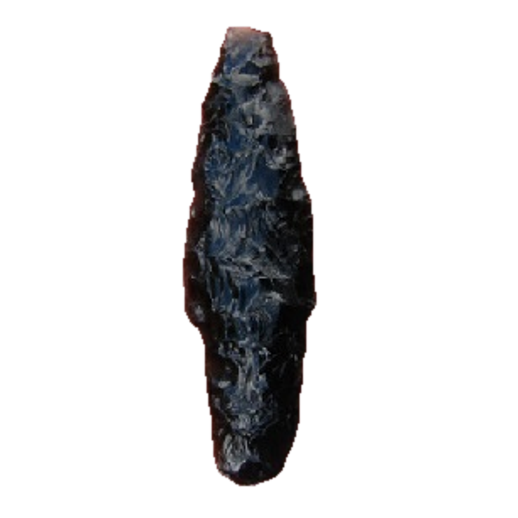
Arrowhead type
Lind Coulee Point
Lind CouleeNorthern Pacific Stemmed Cluster10,500 - 9,000 B.P.Transitional Paleo14 reference photos
Key facts
- Age
- 10,500 - 9,000 B.P.
- Cultural period
- Transitional Paleo
- Culture
- Old Cordilleran Culture
- Size
- Medium to Large
- Shape
- Contracting Stem
- Glacial period
- Late Pleistocene to Early Holocene
More from the Paleo period
Description
This triangular stemmed point exhibits a size range from medium to large, characterized by an elliptical profile. The blade's curvature is variable, transitioning between excurvate and straight forms. The shoulders are often subdued or entirely absent, and when present, may be oriented at an upward slant or remain horizontal. A notable feature of this point is its elongated stem, which can be straight or slightly tapered, accompanied by a convexly shaped base. A common trait observed in these points is the presence of basal grinding. The manufacturing process involves initial broad percussion flaking, followed by a secondary stage of pressure flaking that often obscures the primary flake scars, resulting in a flaking pattern that ranges from random to parallel and horizontally oriented.
Size
The arrowheads exhibit a range of dimensions, with overall lengths spanning 46 to 132 mm. The stem section measures between 18 and 41 mm in length, while the blade itself ranges from 18 to 39 mm in width. The stem width varies from 14 to 29 mm, and the thickness of the arrowhead is consistently between 4 and 5 mm.
Distribution
This type is mainly located in the Washington and Oregon regions of the Columbia Plateau, extending into western Idaho. It is also discovered in Oregon's Cascade range and northern Great Basin areas. Additionally, sightings have been documented in British Columbia's Columbia Frazier Plataea, although the full scope and precise location remain unclear
Mainly found in
Additional information
In a seminal study published in 1956, Dougherty delineated three distinct categories of Lind Coulee points, each exhibiting unique morphological characteristics. The first type is notable for its elongated, slender profile, featuring rounded, weak shoulders that gradually taper into a long, contracting stem, ultimately terminating in a convex base. In contrast, the second type is defined by its triangular shape, with prominent shoulders that can range from horizontal to upwardly angled, accompanied by a slightly contracting stem and a convex base.
The third type of Lind Coulee point is also triangular in shape, but its shoulders can vary significantly, ranging from pronounced to weak. A distinguishing feature of this type is its straight stem, which, like the other two types, is paired with a convex base. Notably, the Lind Coulee point is believed to have co-existed with the Clovis point, highlighting its significance within the context of early North American lithic technology. Furthermore, the Lind Coulee point is considered one of the oldest examples of an early stemmed point, with an estimated age that precedes the Parman point by approximately 1,000 years, underscoring its importance in the archaeological record.
The Lind Coulee point's unique combination of characteristics and its temporal overlap with the Clovis point make it a fascinating subject of study, offering valuable insights into the technological and cultural developments of early Native American societies. As an early stemmed point, the Lind Coulee point represents a critical stage in the evolution of lithic technology, reflecting the innovative and adaptive strategies employed by ancient cultures to create effective hunting tools. By examining the Lind Coulee point within its cultural and chronological context, researchers can gain a deeper understanding of the complex and dynamic nature of Native American technological and cultural development during this period.
Identified by
- Named by
- Richard D. Dougherty
- Year
- 1956
- Type site
- Lind Coulee site (45GR97), Grant County, Washington
Similar types
Types that are easy to confuse with the Lind Coulee point.
- Cascade Shouldered
- Cougar Mountain
- Early Stemmed
- Haskett
- Lake Mojave
- Lochnore
- OYKC Stemmed
- Parman
- Silver Lake
- Taan
- Windust
Other types in the Northern Pacific Stemmed Cluster
- Crescent