
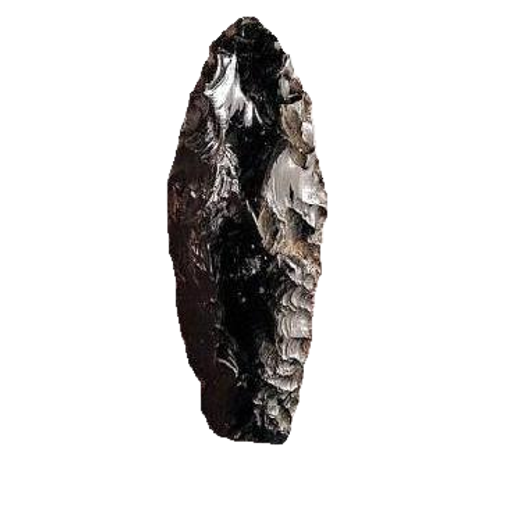
Arrowhead type
Haskett Point
Haskett10,500 - 9,350 B.P.Developmental10 reference photos
Key facts
- Age
- 10,500 - 9,350 B.P.
- Cultural period
- Developmental
- Size
- Medium to Large
- Shape
- Lanceolate
- Material
- Agate
- Glacial period
- Vandal Minimum to Medieval
More from the Developmental period
Description
This lanceolate point exhibits a distinctive morphology, characterized by a medium to large size and an elliptical to median ridge cross-sectional profile. The blade itself is slender and curves outward, displaying an excurvate shape. In terms of width distribution, the blade's maximum width can occur anywhere from the upper third of the point, as seen in Type I, to the upper half in Type II. The lower portion of the point, comprising approximately the bottom half to one third, tapers inward as it approaches the base. A notable feature of this point is the presence of basal grinding, which is typically evident. The base of the point can range from a convex shape to a straight edge. The flaking pattern observed on this point is varied, spanning from parallel oblique to collateral, showcasing a range of technological signatures.
Size
The dimensions of these arrowheads are characterized by a total length ranging from 65 to 115 mm for Type I specimens, and between 110 to 225 mm for those classified as Type II. Additionally, the width of the blade spans from 19 to 38 mm.
Distribution
This type is mainly located in the northern Great Basin region, extending into the Snake River Valley, and reaching the southern slopes of Oregon's Cascades, as well as the northern sections of California's Sierra Nevada mountains. It has also been discovered as far north as the Lind Coulee and Seminole Gap sites in Washington state, and as far south as a location near Delta, Utah
Mainly found in
Additional information
Notable characteristics of the Type I arrowhead include a distinctive widening towards the tip. However, it is essential to consider that this feature may not necessarily indicate a distinct variant, but rather the result of re-sharpening the point. This observation highlights the importance of considering the potential effects of re-sharpening on the morphology of arrowheads, as it can sometimes obscure or alter their original form. By taking this factor into account, archaeologists can gain a more nuanced understanding of the technological and cultural contexts in which these artifacts were created and used.
Identified by
- Named by
- Robert B. Butler
- Year
- 1976
- Type site
- American Falls Reservoir Site, Power County, Idaho
Similar types
Types that are easy to confuse with the Haskett point.
- Agate Basin
- Angostura
- Cougar Mountain
- Cascade
- Lake Mojave
- Lind Coulee
- Silver Lake
- Wildcat Canyon
- Xilju